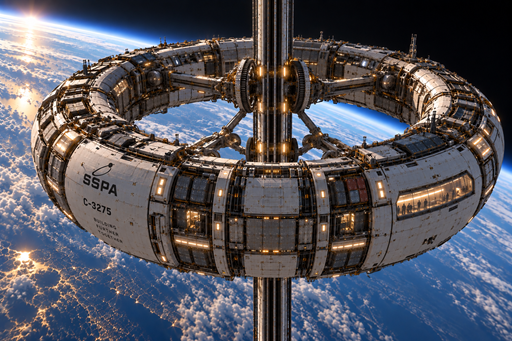
It was a good forty years being a human on the surface of the Earth, Richard mused.
And now he was slowly ascending on a one-way space-elevator ride to the stars.
The Transformation Commission had fought hard for forty. Old enough to have lived a life worth remembering, their literature said. Old enough that what the body had left to do no longer outweighed what could be done without it.
The opposition had a different slogan.
FORTY YEARS HUMAN. THEN THEY CUT YOU OUT.
Richard knew all the arguments. Everyone did. There was a vast difference between knowing a fact and sitting inside its consequences, though, and now he was hours into a climb that delivered cargo one way into space.
He thought he was prepared for the view. Every time he looked down, it reminded him that he never would be.
There was too much Earth to comprehend. Ocean folding into ocean, the long brown wrinkle of mountains he couldn’t name, weather systems spiraling in the middle distance like something alive and thinking. The atmosphere appeared only as a thin blue seam along the curve of the world, so delicate it seemed impossible that everything he had ever loved lived inside it.
With his palm flat against the viewing surface, half prisoner, half disbeliever, he watched the planet slowly become a shape instead of a home.
For two years, people had asked why he wanted to do this. Richard had never found an answer that satisfied them. He had a good life on Earth. That was the point. He wasn’t fleeing anything. He wanted to see the places that had been pictures for most of his life. Mars. The asteroids. The moons of Jupiter. The solar system was finally within reach, and he could go.
The elevator car surprised him. He had expected something industrial, but the designers had made it almost comfortable. It reeked of new construction, hope, and the metallic, too-clean smell of disinfected laboratory materials. A faint structural hum vibrated somewhere behind his sternum and tried to give rhythm to his thoughts.
Everything here was bound for SSPA, Space Station Porta Astrorum. A few hundred thousand tongues had mangled the initials over the years until they wore down into something easier: Espa. Not even the engineers used the full name anymore except on paperwork, the way nobody called a parent by their given name except a lawyer.
Whether Espa still counted as a space station, had become a city, or was slowly turning into an interplanetary nation depended upon whom you asked. For Richard, it would briefly be home.
Something about the empty cabin bothered him. He was the only passenger. Normally the climb was shared by twenty, thirty, sometimes fifty candidates trading nervous jokes and pretending not to study one another’s reflections in the windows.
The cars themselves never came back. They climbed, docked, and Espa absorbed them, folding their hulls and thousands of tonnes of cargo into whatever the city needed built that month.
Everything that went up became part of something. Nothing came down. To Earth, it was almost as if contact with Espa contaminated the material itself. Once it went up, it was no longer welcome home.
In a few hours he would dock. A week of final training waited for him: emergency protocols, interface theory, induction exercises, and a collection of obsolete communication drills the instructors insisted every candidate memorize.
November seventh, arrival. November fourteenth, transformation: Sedation, surgery, and the strange second birth afterward. He would wake without a body and learn, piece by piece, how to see, hear, move, and speak again.
The Commission called the vessel he would soon inhabit a Continuity-Adapted Neuroform, or CAN.
Everyone eventually called it a braincan.
By now, the diagrams had taught him how little space human consciousness actually required. The brain floated inside a shock-resistant nutrient chamber with three independent circulation systems. Synthetic shunts connected it directly to cameras, sensors, and machinery, all protected inside a reinforced nickel-iron shell, forged from meteoroids.
Then they bolted things on: thrusters, manipulators, tentacles, whatever the job required.
Elegance never entered into it. Human beings were symmetrical because nature had spent hundreds of millions of years making them that way. CANs followed a simpler rule: put things where they worked.
The endurance figures had long since become trivia he could recite from memory. Three years of independent operation, though most CANs returned long before that. They hauled, built, surveyed, repaired, and explored, then came back to Espa for nutrients, replacement components, and repairs.
Recruiters particularly loved the fatality statistics.
Negligible.
Better than automobile travel on Earth, they liked to say.
That had always sounded reassuring in a conference room, coffee cup in his hand and his body still entirely his own.
It was less reassuring now.
Tap.
He turned.
Nothing. No indicator light. No panel warning. Just smooth composite and his own reflection, somehow paler than he remembered it being an hour ago.
Tap. Tap. Tap.
A pause.
Tap. Tap. Tap.
Another pause.
Tap. Tap. Tap.
He pressed his ear to the wall and heard nothing. A moment later, the absurdity of the gesture caught up with him. Vacuum waited on the other side. Nothing should be tapping on the hull.
The pattern repeated.
Three short. Three long. Three short.
SOS.
That much anyone knew.
Then the tapping changed.
As he listened, something peculiar happened. The sounds stopped being sounds.
N.
His mind supplied the letter before he could wonder why.
O.
Another pattern.
V.
The tapping continued, and his mind kept translating.
NOV 28.
A pause.
HELLO.
For several seconds he simply stared at the wall.
He had never learned Morse code.
It didn’t feel like learning. It felt like remembering something he’d never been taught.
Above the elevator door, the date display read:
NOV 7.
“Hello?”
His voice sounded too loud.
“Anyone there?”
Nothing.
That bothered him more than the tapping.
Every transport car had a bland, competent computer assistant. It confirmed schedules, offered water, answered questions, and made small, forgettable conversation to keep one-way travelers calm.
What was its name?
Nothing came.
Not forgotten. Vacant, the way a room was vacant when nobody had ever lived there.
Earth hung in the window, unbearably beautiful and far away.
He reached out and touched the glass.
Except it wasn’t glass.
His fingers reported its cool surface. His eyes reported Earth beyond it. Somewhere underneath those two perfectly cooperative senses was a third sensation telling him that neither one was happening.
The elevator vanished.
Fluorescent lights. A whiteboard. Twenty-four candidates sit in loose rows, all of them wearing the particular stillness of people being evaluated. Richard is in the second row with intake forms resting on his lap, still warm from the copier.
“Canshock isn’t unconsciousness,” the instructor says. “That’s the first thing people get wrong. You are not asleep.”
She raps her knuckles against the shell of a training CAN. “Your brain is receiving information the entire time. It simply doesn’t understand what any of that information means.”
A hand rises behind Richard. “How long?”
“Usually a few days.”
“Usually?”
“Think of it as being born a second time. Your old nervous system is the one you’ve spent forty years training. This signal means finger. This one means cold. This one means blue. Then we disconnect it and give your brain a completely different alphabet.”
She snaps her fingers. “So it learns to read again.”
Someone asks the question everyone has been avoiding. “What’s the longest it’s taken?”
The instructor pauses.
“Six months.”
Earth filled the window again.
He staggered backward. For an instant he expected to hit a chair, but there wasn’t one.
The tapping returned.
Three short. Three long. Three short.
His breath accelerated, if he even had lungs.
SOS he could explain.
NOV 28 and HELLO were different.
Why did he know them?
Something pressed into his fingers.
Cheap plastic. Buttons. A flashing light.
Dot. Dash.
“Again,” the instructor says from somewhere behind him.
Dot. Dot. Dot.
“Pattern, letter. Pattern, letter.”
Another voice: “Why Morse code?”
“Because your brain needs language before it needs elegance.”
A training console. Rows of candidates. The instructor moving between them.
“The first ten predated modern induction. Simple electrical pulses were the first thing their brains learned to distinguish. We found out the best way to communicate by accident: Morse code”
A voice asks, “How many answered?”
A pause.
“The three who already knew Morse.”
Then the console was gone, and Earth returned.
“No.”
November seventh. The elevator.
A week of training.
November fourteenth. Surgery.
The tapping said November twenty-eighth.
Two weeks.
He had already been inside the CAN for two weeks.
The planet continued to recede, but the pieces had finally fallen into place. November seventh wasn’t today. The elevator wasn’t here.
He’d ridden up alone. He remembered thinking it was wrong at the time. Of course it was wrong. That wasn’t how he’d ridden up at all.
The empty cabin, the window, the impossible solitude. His brain had assembled them from pieces of his last journey from Earth, building something it could understand because whatever was actually reaching it meant nothing.
He wasn’t on his way to become a braincan.
He already was one.
Two weeks.
Remedial induction started at two weeks.
“HELLO!”
His fist struck the wall.
Nothing.
Again. “I’m here!”
The tapping continued.
SOS. SOS. SOS.
Most candidates connected within seventy-two hours. Some took a week. Two weeks meant intervention, and somewhere beyond that waited the six-month record.
Except for the seven.
His hallucinated hand closed around the nearest object, a metal drinking bottle sitting in the cup holder beside him. It wasn’t real, but it didn’t matter.
He hurled it at the wall.
CLANG.
Again.
CLANG. CLANG. CLANG.
Pause.
CLAAAAANG. CLAAAAANG. CLAAAAANG.
Pause.
CLANG. CLANG. CLANG.
He stopped.
So did the tapping.
“Oh, God.”
Nothing answered.
“Oh God, no.”
Then, faintly:
Tap. Tap. Tap.
A different pattern this time. Shorter. Almost curious.
Its meaning didn’t matter. He threw the bottle again.
One strike.
Pause.
Two.
Pause.
One.
Me here.
Not Morse. Not anything. Just him.
The response came immediately. A rapid sequence of pulses ran through the wall and through wherever his arms connected to whatever now served as his spine.
Then came something for which he had no word.
It wasn’t sound, touch, or sight, though his mind reached instinctively for all three. It was something new, a sensation no human nervous system had ever needed a name for.
Something connected.
The elevator disappeared.
He breathed, or remembered breathing so completely that the memory did the work breathing used to do. He laughed, or remembered laughing. Either way, the relief was real.
“I’m here.”
A pulse answered.
He didn’t understand it yet, but that was fine. He had time.
He had escaped remedial induction. He had escaped becoming one of the stories whispered among candidates about people who went into canshock and never found their way out.
The seven.
Fluorescent lights returned, older and dimmer this time.
Richard walks with the other candidates through the oldest section of Espa, where seven dark cylinders stand in a climate-controlled chamber. The first generation. No manipulators, no thrusters, no cameras. Just life support.
Seven human brains survive transformation but never establish anything the outside world is willing to call communication.
The candidates walk between them in silence. There is something obscene about how ordinary the cylinders look: equipment racks, cables, small green status lights blinking with the patient rhythm of machines that stopped expecting anything to change long ago.
Alive, the lights say.
Nothing else.
Beside one of the cylinders, Richard stops and puts his palm against its shell.
Cold metal.
Something flutters beneath his hand. Not vibration exactly, not electricity. A tiny sensation, gone almost before he notices it.
His hand comes away. “Static?”
The instructor glances toward the CAN. “Probably.”
His attention returns to the green light. “Do you think they’re still in there?”
The instructor considers the question.
“We don’t know.”
The memory released him.
Now the pulses arriving from outside his CAN demanded his attention. Patterns were beginning to emerge. The external system sent signals, and he attempted to echo them back.
Again.
Again.
Again.
A child discovering that moving its mouth produced sound. An infant discovering that the strange things at the ends of its arms were hands.
A brain discovering, one uncertain pulse at a time, that it had become a spacecraft.
Then something touched him.
He went still.
This wasn’t the electronic pulse. It was something else, fainter and somehow underneath it.
A flutter.
He concentrated and felt it again, almost beneath the threshold of perception. It wasn’t language, not even clearly communication, but it was patterned.
He reached for it.
It slipped away.
The instructional signal returned, steady and insistent, pulling his attention back. He tried to hold both signals, but couldn’t. Not yet. He reached for the faint rhythm once more and found nothing.
So he returned to his lessons.
The outside pulses grew easier. Patterns became symbols, and symbols began resolving into letters. His answers came slowly and probably badly, but they came.
Somewhere outside his CAN, technicians watched neural activity climb across their displays and recorded another successful induction.
Inside it, Richard learned his first words.
And somewhere else in Espa, behind several meters of shielding and a door almost nobody opened anymore, seven small green lights continued to glow.
Patient. Steady. Silent.
