It is somewhat funny that everyone is now talking about the cost of AI. Over two months ago, I decided this was going to be a topic of conversation I wanted to address, and I am not even counting the toxenmaxxing shenanigans, which are ultimately noise.
I have now had about six noteworthy LLM-assisted customer service calls. There might have been a few more that I have not paid close attention to. I am going to talk about two of them in particular.
First when I called a really fancy local restaurant to let them know we were going to be about 15 minutes late getting to our reservation due to delays getting the kids to bed before dinner.
The first noteworthy thing about the call was that it was clearly an AI voice. They made it cute by adding a little background noise, including some typing noises while looking up my reservation.
When I explained the issue, that we wanted to inform the hostess that we were going to be late, it took a few different tries to explain “we are on our way but will be fifteen minutes late” before the agent understood that meant we wanted to speak to the hostess. It struggled with the idea that we were going to be late, but it did understand that it was a call worth escalating.
I waited for a moment before the call ended. The “forwarding to a human” part did not work correctly, and the call was dropped.
This brings to mind the second time, as I was onboarding to a payment provider as a contractor for one of my customers. This is a fairly prolific website, and I wanted to upload my EIN information and details about who I am and what I do.
Their fill-out-the-pdf page was busted, and I got escalated to email by a bot, which confirmed that I had a bug.
The email from the payment provider insisted it was a real person and they wanted to gather more details about the issue, including traces from console output, HTML, etc.
I provided all of this, and two times later that day went to test something that still didn’t work.
This standoff lasted about an hour before I decided to just not care anymore until one business day had elapsed.
The good news is that on day two, the Edge browser worked for me to solve the problem of giving them tax information from the browser, and I could go about my business.
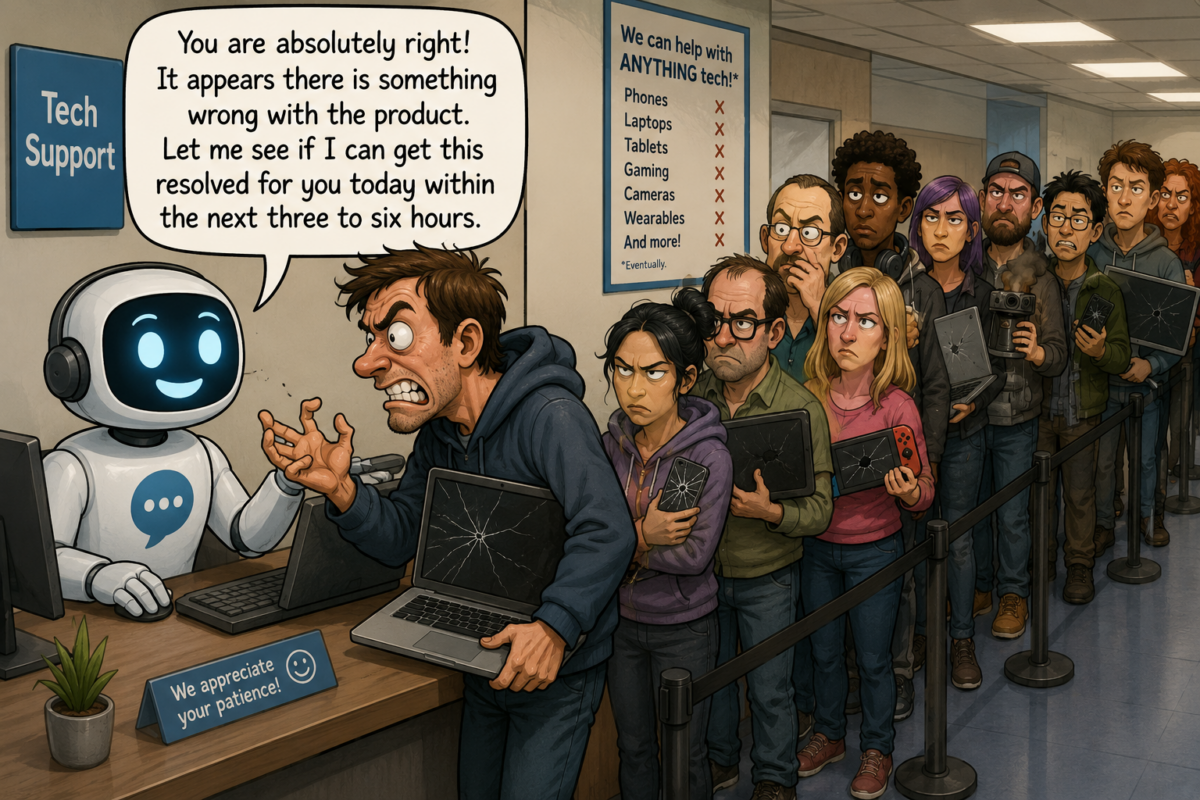
In both cases, the AI agent did not do much to solve the problem, nor did it engage meaningfully.
The failure to do the job correctly for both of these AI implementations, and the damage that it does to the customer relationship, is the cost of AI I want to talk about.
Sure, $500M in tokens is expensive. Companies have spent as much or more trying to rescue brands in the past. In the case of a fancy restaurant and a fairly large billing portal for vendors, these are places that can ill afford to alienate their audience or break trust. Breaking trust is exactly what happens when you deploy an obvious AI customer service system that fails to do its job correctly.
And this is where the real cost of AI will come into play.
There are some things that AI is really good at.
There are some things that AI is not really good at.
In fact, it can be outright terrible, especially if it is easily breakable.
I think everyone has been in a mad rush to show they are using AI to do something, and they went overboard.
Any time you are putting your brand in front of someone and backing it up with an AI resource, you should be really sure it works and that it does what it says.
I met a founder who is making AI tools for the customer service space, using them as training tools to help with role-playing for agent training. Otherwise, people are doing mock exercises that come across as insincere, or they are learning in the crucible of fire of live customer experience. Neither of which is great. The AI tool records the conversation and finds weaknesses and strengths for the future, and maybe helps with a remediation plan for weaknesses. This is a good use for AI in customer service because it only helps the customer.
There might come a time when this will be laughed at as a naive and old-fashioned story. I think that time is probably four to five years away. We will see more and more agents out there doing things, but if you just bolt an agent onto a process and it is not sufficiently baked, you are going to do harm to your service or product.
I am writing this because I spend a lot of time telling people what AI is great for.
I think we should also spend time talking about what AI is not great for.
So if you are about to embark on an AI project, ask yourself some questions about who is going to interact with it, and then, if they have a broken experience, what is the price of that interaction?
The companies that navigate this conversation the best will be the ones with the most valuable brands in the eyes of the consumer. Everyone else will find their business slowly bleeding out and not understanding precisely why.
