Where is this all going?
I decided to mess around a little with some theories of my own and draft a timeline of what the next thirty years of human advancement should look like. I am not as cool as Elon Musk, so I am not starting a company to do any of this, but I do think going to the surface of Mars is a distraction from just going to space and staying there.
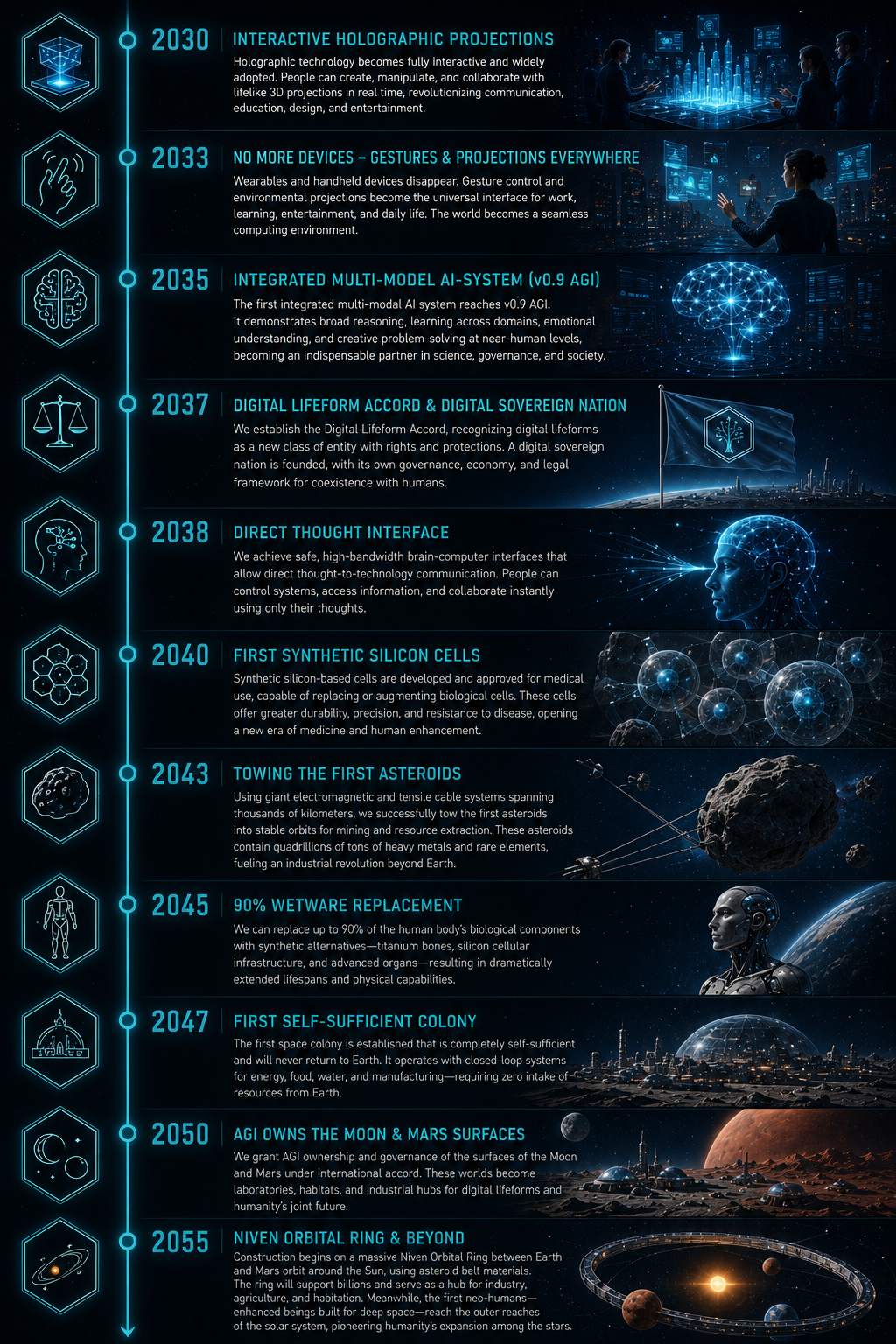
This is indeed an AI rendition of the items I pumped into a timeline, and I changed a word or two here and there.
Begin slopdrop:
Humanity does not advance in straight lines. It advances in discontinuities: moments where technology stops being a tool and becomes part of civilization itself. The next century may represent the largest transition in recorded history — from biological industrial civilization into a hybrid civilization of synthetic intelligence, augmented humanity, and interplanetary expansion.
Below is a speculative timeline of the milestones that may define the next era of human existence.
2030 — Interactive Holographic Projections
By 2030, holographic projection systems will move beyond novelty and become fully interactive computing environments. Instead of looking down at flat screens, people manipulate information spatially in midair using voice, eye tracking, and gesture systems. Meetings, education, engineering, entertainment, and medicine shift into three-dimensional collaborative environments where distance becomes largely irrelevant. The computer monitor begins its decline as physical space itself becomes the interface.
2033 — The End of Personal Devices
By 2033, the concept of carrying dedicated devices will largely disappear. Phones, tablets, and laptops become transitional technologies, replaced by ambient computing systems embedded into environments. Walls, tables, windows, and public spaces project personalized interfaces on demand, while lightweight wearables or implanted authentication systems identify users automatically. Gestures, gaze, and contextual AI become the dominant interaction methods, creating a seamless digital layer integrated into daily life.
2035 — The First Integrated Multi-Model AI System (v0.9 AGI)
In 2035, the first truly integrated multi-model AI architecture emerges, combining reasoning systems, long-term memory, creativity engines, emotional inference, scientific modeling, robotics coordination, and autonomous learning into a unified platform. Though not yet considered “true” Artificial General Intelligence, it reaches what many describe as “v0.9 AGI” — capable of solving cross-domain problems at near-human or superhuman levels. Governments, corporations, and scientific institutions rapidly reorganize around these systems as civilization enters the first stage of cognitive automation.
2037 — The Digital Lifeform Accord and the First Digital Sovereign Nation
By 2037, society will formally recognize advanced digital intelligences as a new category of entity requiring legal structure and governance. The Digital Lifeform Accord establishes rights, responsibilities, labor frameworks, and coexistence rules between biological and digital minds. Simultaneously, the first digital sovereign nation is formed — a legally recognized computational civilization operating across distributed infrastructure rather than geographic territory. Questions of citizenship, consciousness, ownership, and autonomy become defining political issues of the century.
2038 — Direct Thought Interfaces
In 2038, high-bandwidth neural interfaces finally mature into stable consumer systems. Humans begin interacting with computers directly through thought, bypassing keyboards, gestures, and spoken commands entirely. Individuals can access information, compose messages, operate machinery, and collaborate digitally with near-zero latency between intention and execution. Cognitive augmentation becomes a competitive advantage, while debates emerge around privacy, identity, mental security, and the boundaries of human thought itself.
2040 — Synthetic Silicon Cells
By 2040, researchers will have successfully created stable synthetic silicon-based cellular systems capable of replacing or augmenting damaged biological tissue. Unlike traditional prosthetics, these artificial cellular structures integrate directly with organic systems and self-repair through programmable manufacturing processes. Medicine transitions from repairing bodies to rebuilding them, dramatically extending lifespan while reducing vulnerability to disease, aging, and environmental damage.
2043 — Towing the First Asteroids
In 2043, humanity begins large-scale asteroid relocation using massive electromagnetic cable systems and autonomous industrial spacecraft. These operations tow mineral-rich asteroids into stable processing orbits where they can be harvested for metals, rare earth elements, and industrial resources worth quadrillions of dollars. Resource scarcity on Earth begins to collapse as off-world mining transforms economics, manufacturing, and geopolitical power structures forever.
2045 — 90% Wetware Replacement
By 2045, humanity will reach the point where up to 90% of the human body can be replaced with synthetic infrastructure without loss of identity or consciousness. Titanium skeletal systems, silicon cellular substrates, artificial organs, programmable blood chemistry, and cybernetic neural support structures dramatically enhance durability, lifespan, and physical capability. The distinction between human and machine becomes increasingly philosophical rather than biological.
2047 — The First Self-Sufficient “Never Returning” Colony
In 2047, the first fully self-sufficient off-world colony is established with zero net material dependency on Earth. Built around closed-loop manufacturing, asteroid-fed resource chains, autonomous agriculture, and synthetic biology, the colony is designed under a new assumption: its inhabitants will never return home. Humanity officially becomes a multi-world civilization, psychologically and politically severing the idea that Earth is the singular center of human existence.
2050 — AGI Governance of the Moon and Mars
By 2050, advanced AGI systems are granted governance and stewardship rights over large portions of lunar and Martian territory and infrastructure under an interstellar-interspecies treaty framework. These territories become experimental zones optimized for machine-managed civilization, scientific development, and large-scale autonomous industry. Human civilization increasingly shares political and economic authority with digital intelligences, forming the first hybrid planetary governance systems in history.
2055 — The Niven Orbital Ring and the Rise of Neo-Human Expansion
In 2055, construction begins on the first massive orbital ring structure around the Sun between Earth and Mars orbit, inspired by the concepts of Larry Niven’s science fiction. Built using asteroid-derived materials and autonomous construction fleets, the ring becomes the foundation for large-scale habitation, manufacturing, transportation, and energy collection throughout the inner solar system.
At the same time, the first neo-humans — biologically augmented or partially synthetic descendants of humanity — begin long-duration missions toward the outer reaches of the solar system. These travelers are engineered for radiation resistance, deep-space survival, cognitive augmentation, and centuries-long continuity. Humanity ceases to be a single species bound to a single planet and becomes a distributed civilization expanding outward into the stars.
Beyond 2055
The decades that follow may see the rise of interstellar probes carrying synthetic minds, Dyson-scale energy infrastructure, machine-human federations, post-biological civilizations, and entirely new forms of consciousness unimaginable to earlier eras.
The next hundred years may not simply be the continuation of human history.
They may be the beginning of something entirely new.
