Categories
Monocategorized

Recruitability

Happy New Year! Did I say that already? Oh probably. It has been an odd week with my computer being half-alive due to a power supply fan issue. I gutted the beast last night and replaced the old, janky power supply with a new one. If you are in the market for a new power supply, this Amazon Affiliate link will take you to the closest in shape and size to mine. It was also the fastest to arrive at my house. I did order a different one previously and played a bunch of “This is on it’s way!” games with Amazon until they actually conceded that they may have lost the item in question, and I should probably cancel. That journey was several days and several steps.

We did not come here to talk about my computer power supply issues. We also did not talk last December much about “the job hunt”, which is usually what I do in the run up to the new year. Many people pursue career changes in Q4/Q1, and this year, some of them did not do so by choice. LinkedIn was a mess of people slap-fighting about whether or not to hire people with “#OpenToWork” banners on their profiles. As someone who has had a tragic four-year window of hopping from consulting project to consulting project, I feel like I want to level my best Greta Thunberg stay and say, “How Dare You!”

I will add one more thing. Please be kind to people who have lost their jobs. It is cold out there. Not just because it is January and I live in the northern hemisphere.

What advice can I give you if you are job hunting? I have spoken previously about how I break the script in my interviews and given some tips on resumes. I was going to include links to these blog posts… Aaaand then I got tired. They are in there, and you can type one word into the little search box. Like my Amazon Affiliate Ad-related sales, my wisdom does not come easily to you. You have to search for it. You have to find it. If you were all more click-thirsty and generated me some theft-revenue from mister Bezos, maybe I would put in the extra work to make it clickable. See? This Is All Your Fault.

At the moment, I do not have good career change advice. Usually, it revolves around ensuring you have relevant skills, waiting to collect your final bonus check, and what to do when negotiating offers with publicly held companies. None of this applies to anyone who got into a Zoom meeting to be congratulated for being tricked into the room so IT could lock the rest of their account privileges. It also does not apply to people who just got an email and no Zoom meeting at all. I don’t know which group I most empathize with—Both methods are cruel.

I sat down today to discuss shipping software before realizing it is a new year. Now, I feel like I am on a different topic and will go with it.

How do you make yourself stand out in a sea of resumes?

In the world of remote work, some of your competitors might make as much money in one day as you ask for in one hour. This FOPO (Fear Of Pricing Out) is real. There are many countries where 50 Dollarydoos will cover someone’s cost of living for an entire day.

Return-to-office and Hybrid-is-best bean counter nerds are rubbing their hands together gleefully here. Their inability to adapt to the New Normal means they have an edge as an employer for some subset of the population. “You must re-embrace your shit-ass commute!” They say. “You must re-embrace your love of our free coffee, snacks, and choice of sparkling waters!” they say. And by choice, you mean “what flavor of La Croix will you drink today?” and the answer is always “not lime because that’s the flavor everyone already drank, and now it is gone.”

You see? Return-to-office is a bitter hellscape.

But that is not the topic of conversation today.

Let’s pretend you have gotten some kind of interview for a job.

How do you stand out to someone who lives in Cheapostania?

Here are some ideas.

You have desirable skills. You might have three to seven years of experience in an area that a company needs on day one of your new job. Many companies need to balance the costs of training people in technology against solving problems right now. Sometimes, you cannot afford a candidate who is cheaper in price and who can be trained over six months. The long-term costs might be worse.

You have some hard-to-obtain career successes. Whether it is related to the meme-able question, “Will It Scale?” or some fancy-schmancy tech stack that few people use, you may have some competitive advantages over other candidates. I will praise the residents of Silicon Valley for their mastery over projects at scale. Many people can ship software. I have had to come in and perform blowtorch-and-pliers level of work on some systems that have been stood up by people who have not had thousands or millions of concurrent users. These highly desirable skills may make a difference in getting an offer.

You understand how business works. This is hard to measure and is one thing many people fail to grasp. Being able to function in your role is great. Understanding your customers’ needs and the total costs of ownership of your project is even greater. Being able to think outside of the task list is important, and it makes a difference between surviving year-over-year as a business and breaking out and going to the next level.

You can make hard decisions. This might not matter as much in the first five years of your career as it does later. And if you have just been downsized, this might be one of those things you need to demonstrate in your interviews. If you have been working for a decade and cannot think of two to three instances where you have had to make a hard decision, you will likely struggle to find a role that suits you.

You accept that not all decisions are yours to make. This is another big one, and also a scary one. The Amazon Way talks about this quite a bit. “Leaders are right, a lot” and “Disagree and Commit” are two related principles from their list of fourteen. I have had to disagree and commit many times in my career, and I can speak confidently to the times that it was the right thing to do and the times that it turned out to be unfortunate.

You should sound confident. I saved the best for last. Confidence is really important. Interviewing generally sucks. Interviewers sometimes do not want to be there. Interview processes are painful, awkward, and voluminous. Many companies do not have a good grasp on how to hire effectively. I get excited when being interviewed poorly because it is one of my superpowers. You would be surprised that I will tell interviewers this, and it often comes out as a point in my favor. I will bluntly say, “Your company is terrible at interviewing, which means you are probably bad at hiring. I can fix this for you.” You might expect that this will cause an interview to end. Sometimes, it does, and I am relieved about that. I don’t want to work at a company where I cannot fix big problems.

That is quite a list, isn’t it?

When the interviewer asks, “Why should we hire you over another candidate?” This list should give you a few talking points. It may mean the difference between getting an offer and a generic “good luck in your search” reply.

The market is flooded with talented people due to market conditions and emerging talent pools inundating decision-makers with low-cost options to get work done.

These questions will help you get career traction.

Good luck out there and see you next week!

Categories
Monocategorized

Happy 2024!

Happy New Year everyone.

I am not dead or quitting, just uncharacteristically silent. I have a power supply fan in my main PC failing in slow motion, and I am doing the Indiana Jones swap-the-treasure-with-a-bag-of-sand calculations as we speak. I am filled with questions.

Do I change it in the morning?

Do I change it in the evening?

Do I change it less than three days before World of Warcraft Raid time in case my current replacement power supply is missing something, and then I have to do this twice?

So many questions.

Let’s just answer one today:

What are my thoughts on 2023?

I am 50% of the way to my first minimum payout as an Amazon Affiliate Marketer. Yes, I have made five dollars in two and a half years of linking stuff. Keep up the good work, everyone! Your decisions not to click (or buy) anything keep me in contention for Worst Amazon Affiliate Marketer in history.

I have a backlog of two and a half months of blog posts to write. This means that I am still coming up with new things to rant about consistently year after year.

I have embraced Grammarly Premium, but not yet generative AI for my personal writing habits, so much for John always being on the bleeding edge. I have a later post explaining why I am not leveraging this more.

I have started investing in the stonks. Not much, but also not zero. I have had my own “do no harm” theories on money and investing, which have changed this year. This might be too spicy for a blog post. If you are reading this and wondering what I am talking about, then it means you and I should have a 45-minute social meeting to catch up because we have not talked for too long. Please reach out, and let’s get something on the calendar.

I also did not observe much of a change in the “next big thing”… anywhere. 2022 is when we got generative AI; while it has incrementally improved, there is nothing really newey-new-new in 2023.

With all of that said, I am very excited for 2024.

I am embarking on a career journey into “shiny new” territory at work.

I should have one if not two, indie game launches.

I may make a bet for a steak dinner on the timeliness of NFTs, similar to the 2026 steak dinner bet I have for AR/VR, which is still 50/50 even though it is two years away. I think we are going to be four years out on mass market adoption of distributed ledgers in games, and I do not yet have the metrics for said bet.

I apologize for the silence for the past two weeks. The intermittent fan noise of my PC prevented me from putting up the “We will be back soon” sign on the front door. You all deserve better.

I will see you next week!

Categories
Monocategorized

Remotely Interesting

Watching “The Battle For Remote Work” play out in the media is interesting. There is an ebb and flow of articles proclaiming the merits of returning to the office, alternating with articles that extoll the virtues of remote work. I want to make it very clear that I am wearing the “I Heart Remote Work” shirt.

I was meeting with another engineering leader who has a very nice home office. We started talking about our respective setups. That is the modern-day equivalent of strutting your stuff with all of your peacock feathers on display. I suddenly realized there are many successful remote workers I have known through the years, and they all have something in common. Are you ready for me to shock you? Oh wait, you already clicked the link. I do not need to say that.

My realization is that the most successful remote workers and remote leaders have a very well-defined space for doing their work, and it often has very good physical separation from other parts of their home.

Let’s talk about what that looks like, and fill up a post with wonderful Amazon-Affiliate-linked goodies, shall we?

Thanks to one of my kids leaving for college, I have my home office in a full-sized bedroom. It has two desks. An Uplift standing desk and an L-shaped standard sitting desk (from IKEA, do not judge me). I generally have a machine that I dedicate to full-time work and another for personal use (gaming and side projects). Several years ago, I was a fractional CTO for multiple companies and had a desk with a stack of Mac Minis wired up to a single monitor, keyboard, and mouse separate from these machines. Whenever I was doing technical projects, I would insist on being shipped a build/deployment box. This was a very extreme way to ensure that everyone’s intellectual property was compartmentalized, and I believe everyone understood that importance.

The big takeaway here is that not all remote work is the same. Some people perch a laptop on their kitchen table and sit in a dinner chair. Others have separate rooms with sit/stand workstations and custom furniture. It would be interesting to run some studies on the quality of work and the impact of people’s time and space investment into making themselves effective remotely.

Let’s talk about a few other things that helped me succeed remotely.

Get a good chair. I am a fan of the Secret Labs chairs.  They are very heavy chairs and very firm. Some people prefer lighter Aeron-style chairs; if you do, Google that on your own time.

Use consistent peripherals. When I buy mice, keyboards, and ergonomic items, I tend to buy them ten at a time. I am not going to give you an Amazon Affiliate Link for my keyboard of choice because they are no longer being manufactured, and I am a filthy hoarder who will eventually need to knife-fight someone to get the last of these that were ever made.

I do recommend the Razr DeathAdder mouse. It is like someone at Razr asked, “What if people who work for a living are also gamers?” The answer was this mouse.

I buy the same set of ergonomic peripherals, too. This ought to be its own point. I am a big fan of wrist rests, and I got one for my keyboard from Belkin and a different one for my mouse from IMAK. As an added bonus, the IMAK mouse cushion is something you can pick up and toss around while you are rubber-ducking a problem. Just be prepared for it to break one day and spill little beads all over your office.

Make sure you have a good mousepad too. I have a variety of hand-me-down pads and a beautiful World of Warcraft mousepad that I received as a thoughtful gift. I recommend the SteelSeries brand for the ones I buy for myself.

Finally, ensure you have a quality camera, microphone, and headset. I purchased a Blue Yeti microphone that does the job, but I should have bought “the other kind” of microphone because I had to do a bunch of finagling to get it to work. I also had to get a four-foot boom arm because of my ridiculously oversized curved monitor. For headsets, I am a fan-for-life of Sennheiser.

I prefer all of my peripherals to be wired. I have had enough meeting complications and online gaming problems that have originated from someone else running out of batteries. No thank you. Do not want. Zero stars.

There are two reasons I wanted to share this list. The first reason is that I am still trying to dethrone myself as Amazon’s worst affiliate marketer. The second reason is that I have put significant time and energy into making myself effective as a remote worker. I do not know if there is an upper bound on what you can spend to improve your work environment. I do know that I am very happy with my setup, having invested two thousand dollars over the years, and that does not include items that did not make the cut.

Thank you for reading along! I hope that you are happy with your remote work setup. If you are one of those “I Heart Return To Office” people, the good news is that some of the items I linked above are probably things you can buy for your weird previous-century fetish. If I offended you, I am happy to fax you an apology.

See you all in a week!

Categories
Monocategorized

Holiday Poem 2023

Twas the night before Christmas, and we can all see
The world is a mess in twenty twenty three
The Ukraine and Middle East are embroiled in war
We have floods and fires and earthquakes galore
So much is happening, it won’t fit in my head
I had to read up on Wikipedia instead
Blah blah Joe Biden, Blah blah Donald Trump
Washington is a messy and partisan dump
Everyone is ready to complain and to cry
About the best government lobbyist money could buy
In high-tech, we wait for someone to declare
That our computers are now finally all self-aware
I must ask if this is really what we desired
It is probably why Sam Altman was initially fired
He got the job back if you were concerned
Unlike many people who just got “downturn”ed
Companies are trimming, for costs, they are cautious
If you survived the purge, please come back to the office
They are trying to reduce the money they spent
Except, it appears, they want to pay rent
By ratings, in video games, it was a great year
You wouldn’t know it from the layoffs that continually appear
Companies are closing, downsizing, and shrinking
I like to blame thirty percent platform fee thinking
I don’t really know what is really to blame
This was last year: Just more of the same
So double up on your bourbon, your wine, or your beer
And have a merry Christmas and a happy New Year!

Categories
Monocategorized

Blockheads

Hey everyone. We are approaching the holiday season. That means that traffic will be horrendous, and everything you order online will be late. Do not even think about using food delivery services. Your food delivery wait times will balloon, and you might even experience things like your food delivery person showing up in front of your house, throwing two food orders into the street, and then peeling away. When you ask for your refund, be prepared for the automated system to say, “We are so sorry you did not wish to retrieve your food order from the street and eat it.” Yes, this happened, and no, I will never know the full story about that delivery person.

Now that you have been warned that you should spend the next three weeks under your desk whimpering and mainlining hard alcohol, I have a question: Have you ever been in a standup and heard someone say, “I could potentially be blocked on my task”?

No. Just no. Please no? You are not potentially blocked on your task. You are blocked, or you are not blocked. You do not “think about considering the possibility that we are theoretically contemplating the optionality of being blocked.”

Please.

Just be blocked.

It won’t hurt.

It is okay to be blocked.

This is how we get better.

That is it. That is the whole post. I need to go and shower because I realized I could turn this entire post into a TokTok, and I am now unclean.

Before I go, I will throw down my holiday challenge: If I get ten people sharing this brief and incredibly valuable engineering insight on “The Socials”, I will assemble a top ten list of books for you to buy after cheesing me out of my Amazon Affiliate fee. You would think that you want to take money from Jeff Bezos… Why rob hard-working content creators like yours truly?

I will see you all next week.

Categories
Monocategorized

Frame job

I have spent a long time building software. I have also spent a long time managing software teams. Much of my career was spent in very early-stage startups that were usually two to five years ahead of the consumer marketplace, sometimes more. As a result of all of that experience, I have often been asked to become a technical advisor.

Over the course of a decade, the way that I have delivered advice and the way it has been received has changed. I learned that getting emotionally disconnected from the outcome of these projects is important. Sometimes, you are asked to provide feedback and advice so a business leader can make an informed decision. That does not mean they will make the right decision, but it does mean they have at least thought about the outcome for more than five minutes.

I also noticed another interesting phenomenon. I would give some excellent advice in a few cases where another advisor or consultant was also involved in the project. My advice would be ignored, and when the other consultant would give the same advice, they would take it seriously and take action.

I was naturally quite confused at the time.

After two to three years of this, I finally figured out what the issue was. I was not framing my advice correctly.

Much of the time that my advice was being ignored, there was someone else who had worked at a big company who started off their presentation giving a big schpiel about who they were and what impact they had on some big popular project.

“I am Johnny McConsultantFace, and I worked at Facebook on a half-billion-dollar platform where my team raised revenues by two hundred million dollars.” This is an example of how they would start the conversation. When I worked at hi5 Networks as a VP of engineering, I could say, “We had twenty million dollars in declining revenue, and we had to sell the business assets to enable us to do a ground-up reboot.”

So… who would you listen to?

Welcome to the world of framing!

I am grateful that I have had the opportunity to work on more significant projects since then, not the least of which was a two-hundred-million-dollar mobile game that was a leader in its category. When you can preface your presentation with those eye-popping numbers, it gets people to pay attention.

As an early fan of The Meritocracy, I was shocked when I learned how important this is. It is one thing I did very poorly for a long time.

I would go into these presentations armed with graphs, data, and facts, only to sit across from a disinterested executive unfamiliar with the deep technical aspects of the material I presented. Without adding some context as to why that matters, I could have been standing in front of him, pointing at my graphs and repeating the word “loser” over and over.

“Loser loser, loser loser-loser.” I could say and then advance to the next slide, “Loser. Loser? Loser loser! Loser loser loser loser.”

Regardless of the actual words I was saying, this is probably how it all sounded.

Returning to The Meritocracy for a second, I spent years telling people how important it is to work at startups early in your career. I have since reconsidered this advice at least a little. To get the most bang for your buck professionally, you also want to work at a large company on a very large project. I have met many people who have only worked at early-stage startups and many people who have focused exclusively on working for large companies. I think that a blend is the right answer. You get an accelerated pace of learning and familiarity for growth at a startup and some of the credibility of working at scale for a large company.

As you grow into leadership roles, that blend is super important.

I am not generally a person who regrets things. This is one piece of advice I wish that I could give to twenty-five-year-old John. It took me a while to realize how important this is, and I want to ensure everyone can benefit from this belated education.

Thank you for reading along! If you have not finished spending all of your black friday moneys, I have an Amazon Affiliate link for you to click on. Abundance is one of those books that I think everyone should read. It is one of the top five books that helped me transcend professionally and become a better leader. Having said that, I will include links to the other four books in the coming weeks. Maybe “The top five books that John has read” is a better list than “The top five books that John wants to read”?

The call to action here is clear—Your clicks are an important part of the future of content-as-democracy. I shall see you all next week!

Categories
Monocategorized

Boardom

Everyone in high tech tends to think highly of themselves and their outsized impact on humanity. Every new form of internet-plus-pizza-delivery or mental-nicotine-as-a-service we are slamming in front of your eyeballs is a part of some grand revolution. People glare daggers at me when I talk about the current generation of generative AI and how it is largely a machine that averages collective human output. “Our AI is just average?” People exclaim, “That is just mean!” Yessir, I am making that kind of math-based word joke this morning. I am not proud.

Despite my previous short story about machine intelligence I am pretty optimistic about augmenting human intelligence with machine-based intelligence. I know many people out there fear that our machines will rise up against us, and I appreciate your concerns. I know many people cheered the day that it was clear we would replace all of the slow-moving truck drivers, who cut us off on the freeway, with machines—and subsequently became dismayed when it became easier for computers to create artwork. “We want to get rid of the bad jerbs and keep the good jerbs” is something people say to make themselves feel better.

I don’t know that we are on the precipice of welcoming our new machine overlords yet, nor do I think that there is anything to be gained by warning potential investors in AI that “if you bring about AGI, then your investment may help collapse the value of money and put the entire world out of work.” You can Google the origins of that. I tried three times to find the link that included the disclaimer I read yesterday… Aaand then I got tired.

As an early-stage startup enthusiast, I should be more excited about generative AI than I am. Have I become jaded through twenty-five years of this? It is hard to say. I will say that this weekend’s news about Sam Altman And The Very Important Board Conversation has certainly captured a great deal of high-tech mindshare.

So, let’s talk about that for all of you future-CEOs out there.

I have been blessed with some great friends, advisors, and attorneys over the years. Sometimes, people were all three of these things at the same time. I will say that I did more than a little homework on what it means to start a company, and having spent some time in school serving as a part of student government organizations, I think that it is important for people to understand the notion of governance, and your good friends on the Board of Directors.

I have observed over the years that this is one of those things that most people learn the hard way after going through an experience that equates to something that will make it hard for them to sit down for a couple of days. Almost every founder I know has shared a horrible story about how their startup experience went sideways. While OpenAI is a very large company, we are seeing the exact same phenomenon here.

The whole OpenAI story has not yet been written, and with wild claims about employees and investors alike poking the OpenAI board to bring Sam Altman back, I am curious to see where this ends up in a week’s time, a month’s time, and a year’s time.

I hope everyone involved is looking hard at themselves in the mirror and trying to figure out what they could have done differently leading up to Sam Altman’s Very Curious Friday. Given his tweets (and talents), I am not very worried for him. He seems like the kind of person who has plenty of options and will land on his feet.

What about the Board and the employees involved in the decisions leading up to this moment? They are not in the exact same position, in my opinion.

So, what are some takeaways for all of you future CEOs?

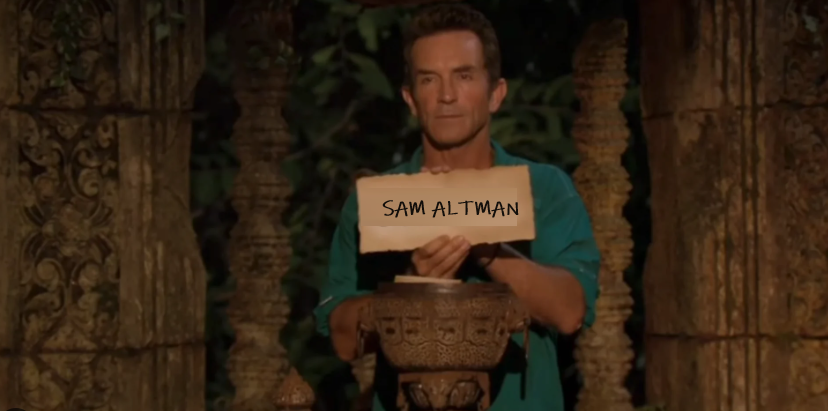
Make sure you understand the makeup of your Board. If you are struggling with this, watch a few seasons of Survivor. The Board of Directors is kind of like the people who vote on the show’s overall winner. At many startups, the CEO will sit on the Board of Directors, and in some cases, they will also be the Chairman. Many investors ask for board seats when they write you a big fat check. Some CEOs also appoint “independent board members” around the same time to ensure they have a good representation when voting for important things. Given what is happening at OpenAI, and conversations to bring Sam Altman back as CEO, I wonder how many of the current Board of Directors will still be there in a week’s time if he is brought back?

Make sure you understand your stock position and your voting rights. The voting rights of many shareholders in a few companies are just polite fiction. Facebook, Zynga, and several other startups had unique corporate structures that put a lot of voting power into one person’s hands. You can see several activist shareholders in big companies like Disney, et cetera, buying blocks of shares before making big moves to change the company. I don’t know that this applies much to OpenAI, but you should educate yourself about it when you build your company.

Make sure you are communicating clearly with your board. This last point is the most important. This was certainly missing here. If you are all communicating well as a leadership team, you don’t Red-Wedding a CEO at a moment’s notice. You also don’t do it on a Friday, but that is a personal quibble. I would hope that anyone taking an OpenAI paycheck is taking a mental health day or three next week as a result of the craziness unfolding. I doubt we will see everyone’s Very Best Work on Monday.

Make sure you are doing the right thing for the right reasons. If everything we read about the motivations for the Altman Incident is all to improve the general safety and goodliness of “Making AI Safe Again,” then this is probably literally the dumbest thing you could do. So, let’s spend three minutes going through the worst-case scenario here. You are taking the person who is the world leader in raising money and pushing the commercialization of generative AI and forcing him out of your non-profit at a moment’s notice on very unfriendly terms. Are you expecting them to go into the corner and sit down quietly for a few years to think about what they did wrong? Or more likely, are they going to go and talk to all of the thirsty check-writing investors out there about how to get absurdly wealthy off of the next iteration of “new internet something-something AI,” alongside the loyal army of well-paid software engineers who are willing to follow them? It seems that is a very likely outcome that will diminish the capabilities of OpenAI even before we ask the question: “With Sam Altman as a competitor unfettered by quote-unquote safety goals, who would write a check to the remnants of OpenAI to keep their staff paid at exorbitant levels, and their server farms running?”

If you measure everything carefully on the surface, Sam Altman has considerable leverage here. There are rumors he is being asked back to the company, and honestly, given everything that has happened, I don’t know how they could make that attractive for him, let alone acceptable. Sam Altman strikes me as the kind of person who is not afraid of getting fired, as is demonstrated by the evidence of… you know… getting fired, and I wager he could raise a pretty substantive pile of money to start NOPEnAI tomorrow.

That is what I think about the whole situation. Who knows what is happening at OpenAI while I write this article, and even what will happen before I publish it?

The only thing for certain is that this is a good opportunity to learn about startups and leadership.

I wish everyone involved the best of luck sorting everything out!

See you next week.

Categories
Monocategorized

Fail to lead

Last week’s blog post was a lot of fun, wasn’t it? I was pleased to find Oasis was available for sale on Steam, giving me a chance to own it again, for the third time. This week, we will return to “career stuff”. In at least two separate conversations this week, I observed the professional importance of being uncomfortable. Being uncomfortable generally means you are in a state of hard practice, which I think is necessary to grow. When I talk to people about taking on their first leadership opportunities, I tell them to be prepared to be in emotional freefall, because they will constantly be on the precipice of failure.

What I find interesting is that I get a large amount of “yeah yeah yeah” for about the first four months, followed by two to eight months of “holy shit, you are not kidding!”

This stuff is hard, kids, and largely because after spending years refining your expertise in one role, you are not quite prepared to change how you think about everything around you in your new role.

If you are being offered a leadership role, I want you to realize that for an indeterminate amount of time, you will be in a steady state of perpetual failure. You will not have enough information to make decisions. You will not have enough time to get everything done. You will not have enough resources for your projects to complete.

You will do one of a few things when you realize this is happening.

First, you might resort to your default tendency, which means doing IC (individual contributor) work alongside your team. This is not without consequences. It means you will spend less time looking at the overall big picture, and also, if you are really good at your job, you may discourage your team when they see how fast or efficiently you do their work. I have seen strong ICs in their first leadership roles blow up their team’s morale and desire to succeed by taking all their projects over the finish line.

Second, you might immediately go into reactive mode. This also hurts because if you spend all your time solving problems, you are abdicating your leadership. You are not setting your team’s direction or pace, and they will begin to resort to their default tendencies. If this happens long enough, your team will go off the rails.

Third, you might resort to extreme negativity. You will describe everything as a risk or a concern and spend so much time collecting all of the “whaddabouts” that you will go into analysis paralysis and render yourself and your team useless.

So what should you do?

First thing, you should take a deep breath. I spend a decent amount of time telling people they should remember to breathe. You cannot let it all overwhelm you.

Second, you should ask, “What is important?” Do you have a list of everything sorted by priority? You should take a look at the most important things first. Once you have a sense of what it would take to get your organization’s most important tasks done, you can pick up the most important thing that has to get done, and make sure it is underway. 

Next, ask, “Do we have any easy wins?” If you have a gigantic slog through the mud for your most important task, is it worthwhile to do a small project to give everyone an easy win and a well-deserved victory lap? I generally tell people that doing large projects can feel like trying to eat a thousand pounds of cardboard—the only way you can do it is one mouthful at a time. Sometimes, it is important to break up that cardboard-chewing to boost team morale.

Finally, you should also make sure you are communicating your concerns to the organization. I remember the first time I had to get on the phone with an executive to discuss a multi-million-dollar production problem. I was terrified of what the reaction would be. When I made the call, I was rewarded with a grateful-sounding “Thank you for letting me know!” The leadership team immediately went into problem-solving mode. I assure you that while you may be afraid of making the call to communicate a problem, it is much worse to be radio silent and for executive leadership to learn about problems from somewhere else! I spend a lot of time trying to instill in people the importance of early communication about issues. The more time you have to think about a problem, the more likely you will have an intelligent solution.

When leveling up into a leadership role, you need to develop new habits and ways of thinking. Make sure you give yourself enough time to develop these behaviors. Reflecting on week-over-week performance and feeling discouraged is easy because nothing feels different in the near term. Most people taking on leadership roles have been getting frequent feedback up to this point. You will need to get accustomed to getting less and less direct feedback the higher you go professionally.

Thank you for reading along! If you are looking for a good read, I am going to attempt to squeeze some nickels out of Jeff Bezos, trying to sell you a copy of my favorite book on habits: The Power of Habit. Of course, you are habitual non-clickers on my Amazon Affiliate links. I will start dropping vapid top-ten links soon since my refined attempts to instill great purchasing habits have failed.

I shall return next week, zero billion dollars richer.

Categories
Monocategorized

John is a bad designer

They say you will eventually be the villain in someone else’s story. What happens when you become the villain in your own story? This story is fifty percent confession and fifty percent personal therapy.

In 2003, I took a role as Director of Development at Digital Chocolate. I did not have the presence of mind to advocate for a higher-level role. While I probably did not qualify for it on paper, I think it would have helped the business immeasurably due to how the first year turned out. By six months, I had simultaneously shipped one of the better-selling launch titles for the company and turned in a resignation. I think I have spoken about some of those challenges in other blog posts, and I appreciate that Trip talked me out of quitting. At the same time, the next six months were essentially me trying to make sense of being on the struggle bus.

Enter Oasis.

One of our developer partners for mobile games at the time was Mind Control Software, a company helmed by Andrew Leker. Andrew is a game developer’s game developer. I really enjoyed learning game design from Andrew and his entire team. While they were developing one of Digital Chocolate’s early titles, he was also developing a great little game called Oasis.

I don’t remember how it came up, but I was able to get a copy of the game early on to help test it.

It was love at first sight.

Oasis is essentially a speed-round of Civilization. It captures the charm, beauty, and mystery of the early phase of Civilization. This is the part of the game I totes adorbs. You have a finite number of turns to build up your cities into a connected nation-state, and when the turns are up, a barbarian horde descends on the map and tries to destroy it.

I could spend about an hour or two explaining all the intricacies of Oasis and still not be close to capturing how magical this game is.

Andrew and his team knew I was in love with their game, and I sincerely appreciated the opportunity to test it and give some feedback on the product. I probably drunk-texted my appreciation to Andrew a little too much. I was having an unusual year, and this was one of those “mistakes were made” moments for me. That year at GDC, they made t-shirts for Oasis, and I remember calling Andrew and asking if I could have the game logo ironed onto the inside of the shirt instead of the outside so it could be closer to my heart.

I loved that little game so much. I still do.

The best part about this little love story is that I have a credit on Mobygames as a scenario designer. Don’t stare too hard at the rest of my credits, you filthy creepers, because it does not include a plethora of games that I am proud of. Let us go back to the story.

Before the game went live, Andrew asked me if I would help test out the level design system for the game. I told him that I would not do it. Just kidding. I leaped into that with both feet. They had a configuration file you could use to tune levels, and I was happy to put it through its paces. I spent the next few days on evenings and weekends making an interesting little twelve-part story that was expressed through the configuration file.

I was incredibly grateful for this opportunity to do something creative due to the work challenges I was having at Digital Chocolate. I feel quite strongly that side projects give people tremendous benefits, and while I was filing at the bars of my cage at work, this project gave me amazing therapeutic value.

After sending it over to Andrew and his team to check it out, he called me up and gave me kudos for making an interesting story. He asked me if it was okay to include it in the final shippable game. Be still my beating heart! Of course, I said yes! I was humbled that this creative extracurricular task would see the light of day!

I remember being excited to check it out when the game finally shipped. It won two awards at the Independent Games Festival that year, one for game design and one for the Seamus McNally Award for downloadable games. I bought two copies of the game. One digital copy as soon as it was available so I could play the game and support indie development. I also bought a physical copy when I finally found one in a game store because I am one of those “must buy the physical thing” people.

I remember unlocking my little scenario in the game and playing it through.

This is where the lovely Hallmark Movie music starts to slow down and go off-key.

I have to change gears a second and talk about John, the player of games. One of the things that I tell people who want to pursue a career in games is that you never look at games the same way again. You always have this observer on your shoulder, taking notes and making fourth-wall-breaking comments as you play. You ask yourself what you like. You ask yourself what you don’t like. You gently “tut tut” gaffes in the first-time user experience and reflect on how you would improve this game. I am no different. Thankfully, there are a few games where their blazing brilliance makes this voice a tiny whisper at best. Terraria, Minecraft, World of Warcraft, Vampire Survivors, and Ultima IV are the best games by this unusual measure. It does mean I have a small stack of games that I fear to open. The little angry observer on my shoulder glares at me as I write this because he wants to be heard. I fear his voice, and I want to turn to him and scream, “Just let me play the fucking game!” 

There are a few chief criticisms that he levels at some games, and two of them are ones I vehemently agree with.

The first thing that I detest is jumping puzzles. There are a few jumping puzzles in World of Warcraft. There is precisely one entrance to a dungeon with a jumping puzzle, and I avoid it like the plague. Shame on the level designer who thought I would look for one-up mushrooms and hidden coins in Kalimdor. Super Mario is four doors down.

The second thing I detest is cheap designer meta-gaming. Sometimes, a developer constructs an “aha” moment inside of a game where, to solve a particular problem, you need a piece of player knowledge that is generally only available by attempting the puzzle and failing to solve it. “Ha ha ha! Stupid player!” He intones, as you die and hit the retry button, “I am smarter than you!” I hate that so much because it is a stupid design trick.

You can see where this is going.

The scenario I constructed for Oasis had a player traveling through twelve islands. Each island included different challenges and used different parts of the scenario design tools. By the time I got to the eleventh island, I was largely out of good ideas. Without going into too much detail, each city in the game could include a treasure that would help you, and in one case, the city could also include a traitor that would turn the city against you at the end. I decided to test this out and make a level where you needed to waste a click on every city because I made every city except for one possess one of these traitors. That meant you needed to find one city and beef it up like crazy to survive the game-ending assault.

That is right. 

“Ha ha ha! Stupid player! I am smarter than you!”

There is a brief hint in the narrative that this moment is coming. The only way to really understand how to beat this level is to get to the end of it and see how many traitors are on the map.

That is right. In the interests of science, testing, and love of a great game, I defaulted to the most base of all designer patterns and trumpeted my shameful cleverness over the player base.

I became the thing that I hated the most.

The good news is that while the game was celebrated as an amazing design marvel and is essentially “a game developer’s game,” it was not a commercial success. Very few players were harmed by this.

It is simultaneously one of the things I am proud of, having contributed to the scenario design of a game I love to play, and ashamed of for the unspeakable crime I committed against my own design sensibilities.

What an amazing journey, right? I am emotionally spent after confessing my professional sins here.

I have to apologize for not writing anything last week. I did not put my “See you next week!” post-it note. Last week was Halloween weekend, and high winds and scheduling conspired to blow up my writing habit as I struggled to get my various and sundry decorations set up for Tuesday’s festivities. We go all in on Halloween here. Full-sized candy bars. Giant inflatable spiders and pumpkins. We even have a twelve-foot arch where most neighborhood holiday selfies happen. So it is for a good cause. I ignored you all because of the children. I would put an Amazon Affiliate Link for the said arch. Alas, it was a Spirit of Halloween purchase, so I cannot unreasonably collect nickels from Mister Bezos.

I hope you forgive the gap, and I will see you all next week.

Categories
Monocategorized

Indirect Coaching

One of the most important things you can do as a leader is to coach people. I do this with coworkers, I do this with my family, and I do this with about half a dozen other people on a part-time basis. Helping people grow is really awesome, and most times, it is its own reward.

It is also very hard to do. One thing I remember from childhood was watching my father try to coach my brothers on the farm. Sometimes, he would explain a particular job to them, and it was clear they weren’t interested in learning to do it his way. He was pretty insistent about doing it his way because he learned some painful lessons in the process. When it was clear he was not getting through after repeated explanations, he would sigh and tell them, “Remember, when you are sticking your hand in the fire, you are dragging my hand along with yours.”

It was a particularly gruesome metaphor that stuck with me all these years because it was so apt. Now that I am all growed up and managing people, I find myself understanding where he was coming from. Sometimes, the people you are coaching will ignore your recommendations because you learned something valuable from failing that you are trying to convey to them in words.

So what can you do?

Welcome to the world of indirect coaching.

Indirect coaching happens when you help someone decide independently rather than telling them directly what they should do.

The Socratic Method is one way you can indirectly coach people. You can ask a series of questions to people to help them understand the outcome.

“What do you think you should do here?”

“How will the customer respond to your change?”

“What will happen when you push that code to production?”

“What will the product management team say about the changes to this feature?”

“Is there anything missing in your proposal?”

There are lots of questions you can ask people to see if they can reason it out on their own.

Sometimes, the answers you will get need to be corrected and indicate a lack of awareness or understanding of some element of the problem you are working through. This happens more often than you think.

When faced with someone not responding to coaching, you can walk them through a few likely scenarios about what will happen, or perhaps have a deeper conversation to help them become aware of things they are not considering when making their decisions.

Another effective indirect coaching tool is to rope in an additional leader or coach to help teach a valuable lesson. This is an especially powerful tool if you have teenagers and they have sports coaches or influential teachers. Whenever I needed to give my oldest son some important feedback, I would ask one of his coaches to talk to him about it. I have also asked peers at work, and sometimes even my boss, to help coach people on my teams. Bringing another voice to the conversation is an excellent coaching tool.

These are just a few ways you can coach people more effectively. Understand that people learn and grow differently; not everyone will respond to the same coaching techniques. Developing your coaching repertoire also takes time, so it is better to start experimenting sooner rather than later.

I tell everyone interested in leading and coaching that they should consider volunteering for a youth sports organization. I learned much about coaching people from AYSO soccer and Little League baseball. Both organizations give you a lot of training on how to grow and nurture young athletes. For young kids, you also get to witness a tremendous amount of growth and progress from eager and impressionable young minds over the course of the sports season.

The next time you are helping someone at work, and they are not picking up what you are putting down, maybe it is time to change your tactics. Try to coach them indirectly and see if it makes a difference.