Categories
THIS ONE IS OFF OUR NEXT ALBUM

This was set as uncategorized. But if there is one category, is that not wrongly named?
The reader’s choice topic month came and went. Thank you to all who voted. It wasn’t like there were thousands of you, but it was enough to help me break through a “what the hell do I post” deadlock. Onwards and upwards.
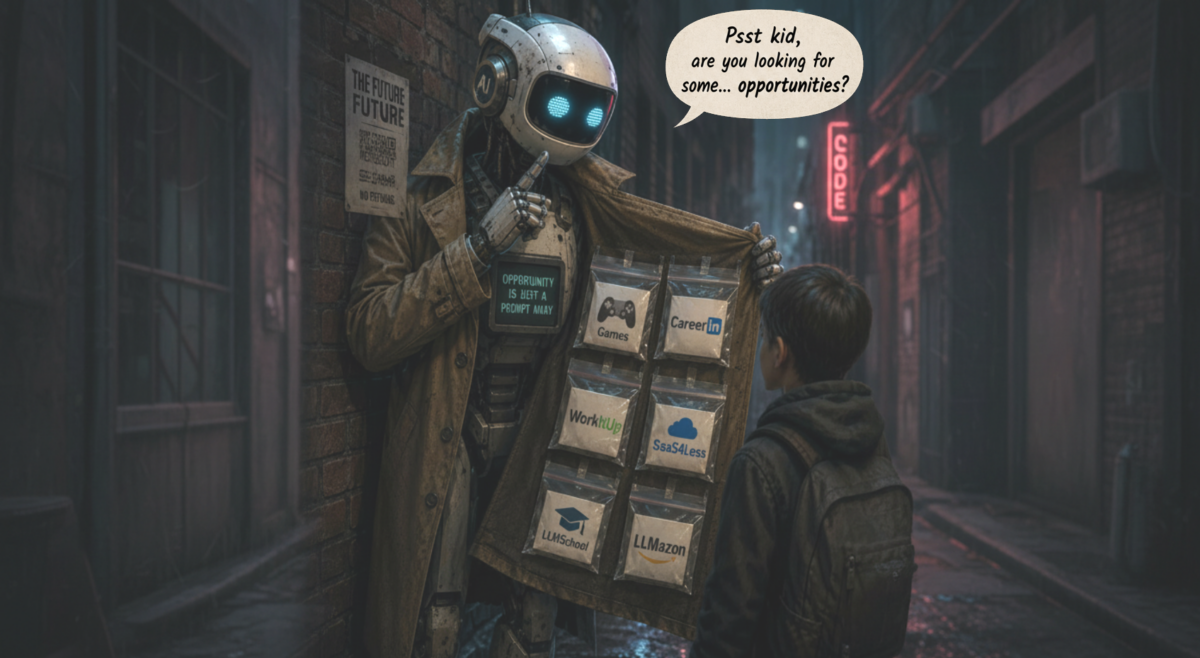
This week, I wanted to armchair a little on the world we live in and spot the best places to deploy AI. Where are the “aipportunities,” shall we say.
There are two ways to go about this.
The first way is to look for blue oceans and greenfield opportunities. Where are the new categories springing up, and where are there places for things to exist where they never existed before?
This is your agentic workflows, your vibe-coding tools, and your openclaw instances hard at work.
You can GPT up your Chat if you need to know more, or attend a meetup.
The other really good way is to find someone who has set themselves as an anti-ai platform and is viciously spending time and money defending their moat.
There are three obvious leaders here I want to talk about.
The first is LinkedIn.
The second is (shocked Pikachu face) the games industry.
The third is Upwork.
Let’s talk about these, shall we?
LinkedIn has set itself up to be a laughingstock as a platform. If you have not seen one of my “It is Day NNN” posts, you should creep me over there. You might recognize what I am posting about because it is infested with horrible noise.
The noise is largely because the platform has done its best to keep collaboration with AI to a near minimum, and I have heard horror stories about people being banned from LinkedIn for experimenting with API tools.
Considering they are owned by Microsoft, and seeing literally every misstep possible being made by Microsoft, this is just another leadership category error in the making.
After LinkedIn, there is “the whole games industry.” Games have 100% always been at the forefront of every technological wave of innovation. Except for LLM technology. It is borderline lunacy how toxic LLM technology and LLM developers are treated in games. I am on the receiving end of this myself, and I have not even shipped an LLM game yet. I get people sneering at me, making horrible comparisons in passive-aggressive vaguebooking posts, and flat out being blocked for being enthusiastic about the incoming change in tools that we will be experiencing. I do my fair share of trying to help people agree to be open to new tools and processes using LLM tools, but I have stopped being kind after a first-degree connection literally was gaslighting me and attempting to patronize me into accepting that his toxic treatment of my opinions was normal and that somehow I am more stupider for not understanding why I am so horribly bad.
I am going to painfully wait for the tantrums and thumbsucking on this front ride itself out. There is no other real alternative. I am not going to attempt gentle Socratic conversation anymore. I am just going to point out they are throwing tantrums and point out that “The Big Beige Book of 2028 Employability” will require people who can spell LLM. I describe it as painful because any time I try to offer a constructive path forward for people, they smack it down like a toddler breaking a plate full of delicious vegetables. Then they scream in my face, “NO LIKEY!”
At some point, like every other technology wave before this one, someone is going to ship a hit game, and then ten other companies are going to knock it off. Then AI Native games will have a proper genre, and we can all go back to normal.
That brings us to Upwork and its ilk. Much like LinkedIn, here is a protectionist ratings racket for work. They have APIs that they apparently hoard zealously in a pathetic attempt to extend their moat for pushing developers into low-leverage roles, where customers can threaten them for discounts due to one-sided reputation management. “Give me an extra milestone’s worth of work or you get one star,” is a motivator for someone who is already struggling to make ends meet. That lack of reputation will make it harder for you to command your existing clientele or wages.
I have more on how Upwork will eventually perish in the darkness where it thrives, but there will be trustable transparent platforms leveraging LLM technology to make better developer pairings with projects, and also whole new ways to do this business without having it be a complete race to the bottom that commoditizes hard-working creative people. You might have to wait until mid 2027 to hear more of this. For now, I will keep it secret, I will keep it safe.
So here are three places you can make a tectonic impact against competitors playing “scared ostrich” for their strategy. Pick one of these, or find something that has a similar set of wrong-thinking leadership forcing people into business relationships or using scarcity tactics.
There are many others out there. If you pick one, figure out a transparent model, and figure out how to create value and joy for people through the wonder of next generation LLM tools, you might be able to take over a shameful protectionist who is huddling under their desk day drinking and wishing all of these new developments would stop so they could just croon lovingly with their fax machine and their horse and buggy like the good old days.
Until then, bad man Darth Szeder will go away for a little bit so you can put on some Kenny G, take out the tub of ice cream from the freezer, and make some chamomile tea, or whatever it is you need to do after you absorb his mean old words.
I will undoubtedly be back for more of this next week.
Maybe with an Amazon Affiliate Link. You know, because apparently I want to push more money at mister Bezos, since I am already not a bad enough mans.
It is somewhat funny that everyone is now talking about the cost of AI. Over two months ago, I decided this was going to be a topic of conversation I wanted to address, and I am not even counting the toxenmaxxing shenanigans, which are ultimately noise.
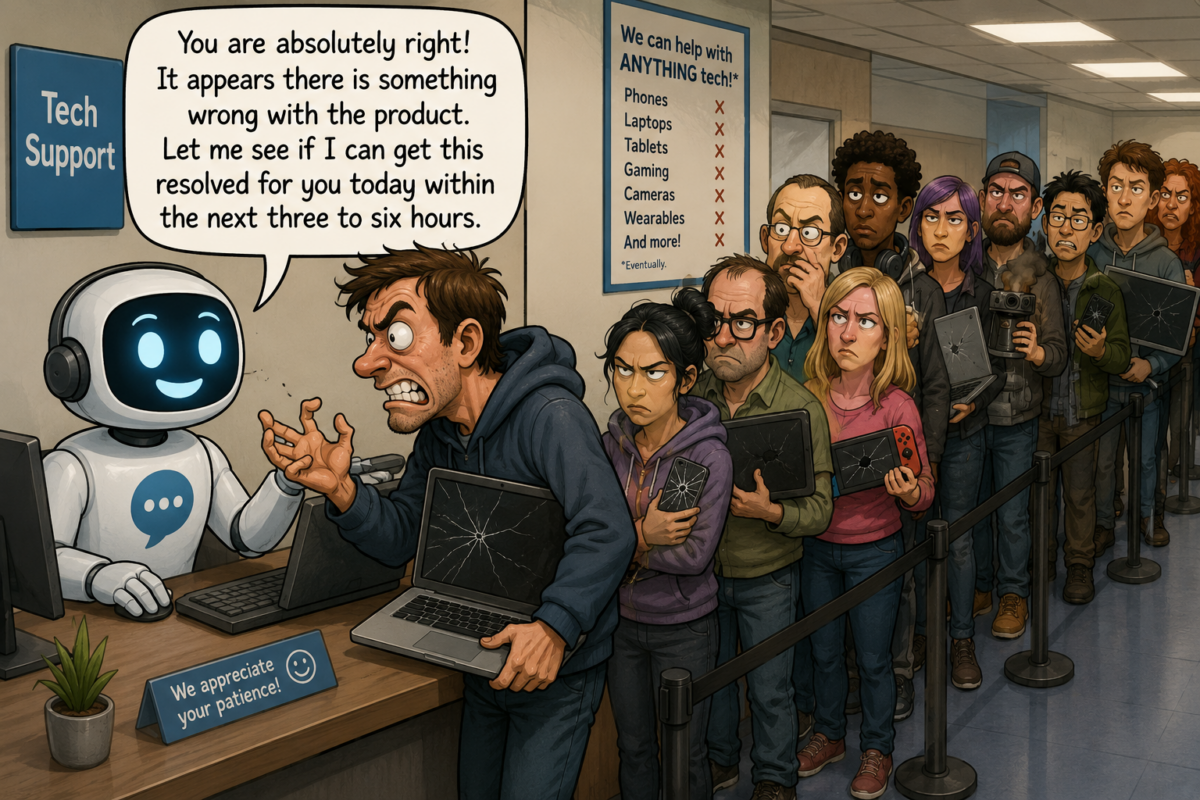
I have now had about six noteworthy LLM-assisted customer service calls. There might have been a few more that I have not paid close attention to. I am going to talk about two of them in particular.
First when I called a really fancy local restaurant to let them know we were going to be about 15 minutes late getting to our reservation due to delays getting the kids to bed before dinner.
The first noteworthy thing about the call was that it was clearly an AI voice. They made it cute by adding a little background noise, including some typing noises while looking up my reservation.
When I explained the issue, that we wanted to inform the hostess that we were going to be late, it took a few different tries to explain “we are on our way but will be fifteen minutes late” before the agent understood that meant we wanted to speak to the hostess. It struggled with the idea that we were going to be late, but it did understand that it was a call worth escalating.
I waited for a moment before the call ended. The “forwarding to a human” part did not work correctly, and the call was dropped.
This brings to mind the second time, as I was onboarding to a payment provider as a contractor for one of my customers. This is a fairly prolific website, and I wanted to upload my EIN information and details about who I am and what I do.
Their fill-out-the-pdf page was busted, and I got escalated to email by a bot, which confirmed that I had a bug.
The email from the payment provider insisted it was a real person and they wanted to gather more details about the issue, including traces from console output, HTML, etc.
I provided all of this, and two times later that day went to test something that still didn’t work.
This standoff lasted about an hour before I decided to just not care anymore until one business day had elapsed.
The good news is that on day two, the Edge browser worked for me to solve the problem of giving them tax information from the browser, and I could go about my business.
In both cases, the AI agent did not do much to solve the problem, nor did it engage meaningfully.
The failure to do the job correctly for both of these AI implementations, and the damage that it does to the customer relationship, is the cost of AI I want to talk about.
Sure, $500M in tokens is expensive. Companies have spent as much or more trying to rescue brands in the past. In the case of a fancy restaurant and a fairly large billing portal for vendors, these are places that can ill afford to alienate their audience or break trust. Breaking trust is exactly what happens when you deploy an obvious AI customer service system that fails to do its job correctly.
And this is where the real cost of AI will come into play.
There are some things that AI is really good at.
There are some things that AI is not really good at.
In fact, it can be outright terrible, especially if it is easily breakable.
I think everyone has been in a mad rush to show they are using AI to do something, and they went overboard.
Any time you are putting your brand in front of someone and backing it up with an AI resource, you should be really sure it works and that it does what it says.
I met a founder who is making AI tools for the customer service space, using them as training tools to help with role-playing for agent training. Otherwise, people are doing mock exercises that come across as insincere, or they are learning in the crucible of fire of live customer experience. Neither of which is great. The AI tool records the conversation and finds weaknesses and strengths for the future, and maybe helps with a remediation plan for weaknesses. This is a good use for AI in customer service because it only helps the customer.
There might come a time when this will be laughed at as a naive and old-fashioned story. I think that time is probably four to five years away. We will see more and more agents out there doing things, but if you just bolt an agent onto a process and it is not sufficiently baked, you are going to do harm to your service or product.
I am writing this because I spend a lot of time telling people what AI is great for.
I think we should also spend time talking about what AI is not great for.
So if you are about to embark on an AI project, ask yourself some questions about who is going to interact with it, and then, if they have a broken experience, what is the price of that interaction?
The companies that navigate this conversation the best will be the ones with the most valuable brands in the eyes of the consumer. Everyone else will find their business slowly bleeding out and not understanding precisely why.

I don’t know how to say this without hurting someone’s feelings, so I am not going to bother to try. Some builders are terrible at making user interfaces. I don’t have to wish for a dollar for every minute that I have spent fixing user interfaces. I do, in fact, get paid for exactly this sometimes. I believe that I have come in with a blowtorch and pliers to these kinds of projects for two-thirds of my career, possibly more.
A lot of builders will focus on making an interface that maps to the basic API elements they need. If you have done this enough times, you will know that I am speaking about the CRUD interface that gets mapped to a data set. Create, Read, Update, and Delete. The four horsemen of the one-star review on Yelp. If this is your idea of a perfect interface, then I have unkind words for you. You should be banned from using Figma, CSS, and any of the LLM tools for writing software.
In many ways, I often believe that form follows function. If I only have a hot neon yellow t-shirt and lime green spotted pants in the closet, that’s what’s getting loaded onto my frame before I emerge to face the world. I won’t give a second thought, even after blinding drivers in their cars who crash into each other when I am out walking. It’s not me, it’s them.
Despite that utter deafness to fashion sensibility, I do think there is an aesthetic to “form follows function” as it relates to software. The pixels may be hot neon colors, but the structure and the flow need to make sense.
If you do not know what I am talking about yet, and you know how to spell TCP/IP, then hold still, my friend. You are in danger. Blink twice. Fear not, though, intrepid software extruder, I am coming to redeem you with my hastily scribbled letters and bombastic psycho-babble.
I have stuffed my face into a design book or two when no one is looking, so I can improve at delivering elegant software. These are links to books in design and taste, and they are also Amazon Affiliate Links. I will patiently work towards getting nickels from mister Bezos with your help, and I understand that you might not yet feel ready, and these books are not Dungeon Crawler Carl.
We have arrived near the end of the page and well past the limit of the average TokToker’s patience.
Now that they are all gone and only the Quality Readers remain, it is time to divulge secrets.
I place a great deal of distinction between functional software and usable software.
What does that mean?
Functional software arrives as a hot mess of CRUD panels, very few popups, and usually an incorrect ordering of tabs in the navigation system. You have to hop around like a Kangaroo who is more than halfway through your case of beer.
By contrast, usable software just… flows… The most usable software effortlessly melts away your objectives with minimum hassle.
With functional software, you will be angrily stabbing keys and clicking buttons that rack up touch counts from interaction to interaction with mounting tedium.
I will say that most usable software starts off functional. You can iterate your way from your first deliverable to greatness that is admired by your customers and users.
Some simple questions that have guided me on my road to usable software over the years.
Can users figure this out on their own?
Are there nine or fewer things on the screen?
Can people make use of the software quickly?
Does the cognitive load of day-to-day tasks go down using this software?
Is it leaps and bounds better than the alternatives?
I know there is a thirsty bunch of builders out there who live their MVP dreams every day. Not all Minimum Viable Products are usable. I think that the most usable MVPs will win more often in the marketplace than those that are just functional.
This has come up a few times in the past few months. The layer at which people “something something AI” every day is currently out of reach for a lot of people. Some of it is at the functional level of delivery, and some of it, if you drink three beers really fast and squint at it, is usable.
The race to ship constant functional feature after functional feature, 50 to 60 hours a week, will tend to overload most vibe coders, too, who didn’t realize that the LLM tools of code generation have promoted the average engineer into product management without them even looking. Apparently, it is making them tired and burning them out. Kinda makes you have a little more respect for those product managers you used to laugh at in their Miro and Trello boards all day.
This is all happening as you sit there being told over and over again, “You are absolutely right!” when software gets spit out of the other end of the model.
Why is this at all important?
Well, if you are looking for ideas to establish yourself as a tastemaker and make yourself less vulnerable to getting blasted by the pink-slip-job-away cannon in the coming years, this is a good place to start!
Where is this all going?
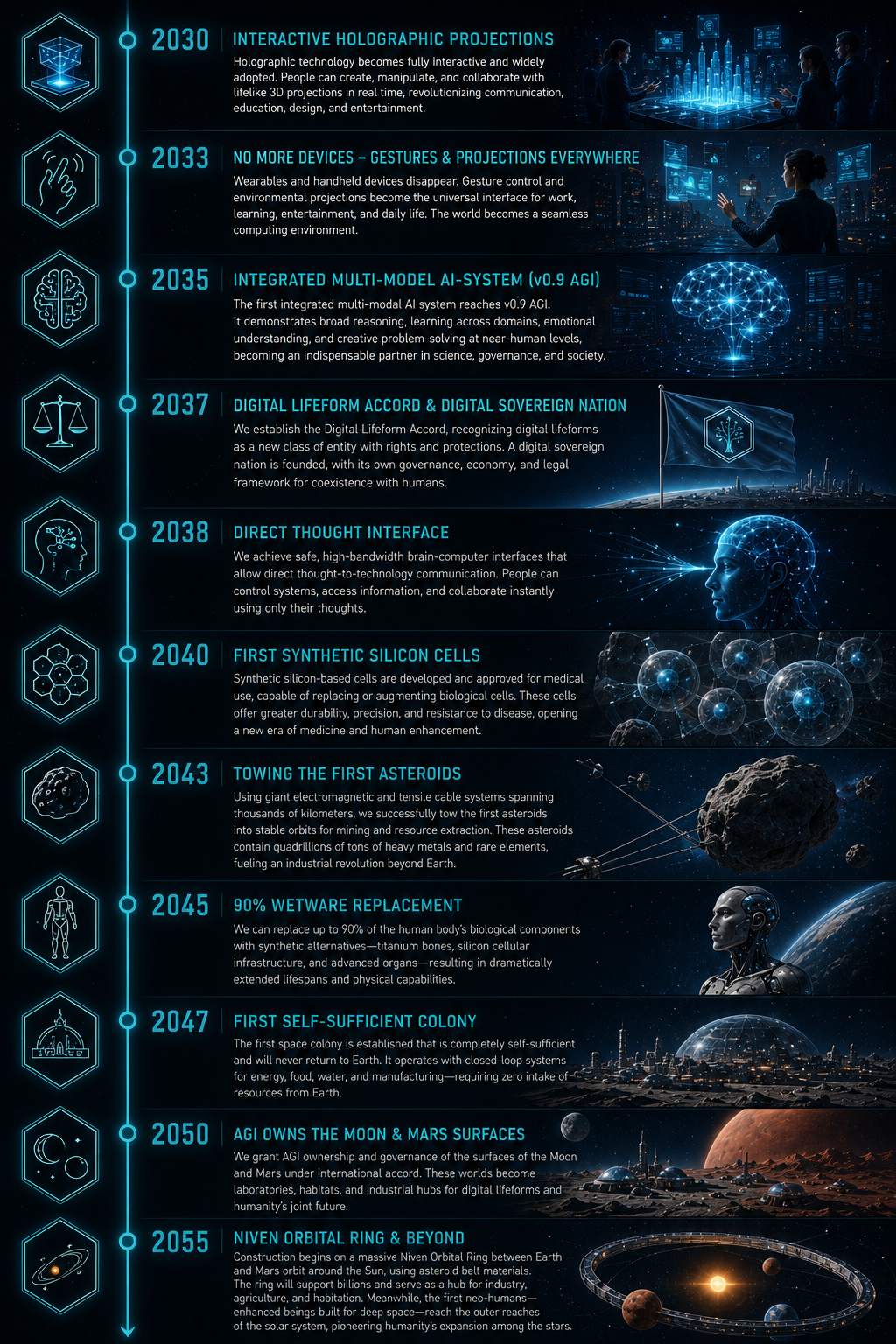
I decided to mess around a little with some theories of my own and draft a timeline of what the next thirty years of human advancement should look like. I am not as cool as Elon Musk, so I am not starting a company to do any of this, but I do think going to the surface of Mars is a distraction from just going to space and staying there.
This is indeed an AI rendition of the items I pumped into a timeline, and I changed a word or two here and there.
Begin slopdrop:
Humanity does not advance in straight lines. It advances in discontinuities: moments where technology stops being a tool and becomes part of civilization itself. The next century may represent the largest transition in recorded history — from biological industrial civilization into a hybrid civilization of synthetic intelligence, augmented humanity, and interplanetary expansion.
Below is a speculative timeline of the milestones that may define the next era of human existence.
By 2030, holographic projection systems will move beyond novelty and become fully interactive computing environments. Instead of looking down at flat screens, people manipulate information spatially in midair using voice, eye tracking, and gesture systems. Meetings, education, engineering, entertainment, and medicine shift into three-dimensional collaborative environments where distance becomes largely irrelevant. The computer monitor begins its decline as physical space itself becomes the interface.
By 2033, the concept of carrying dedicated devices will largely disappear. Phones, tablets, and laptops become transitional technologies, replaced by ambient computing systems embedded into environments. Walls, tables, windows, and public spaces project personalized interfaces on demand, while lightweight wearables or implanted authentication systems identify users automatically. Gestures, gaze, and contextual AI become the dominant interaction methods, creating a seamless digital layer integrated into daily life.
In 2035, the first truly integrated multi-model AI architecture emerges, combining reasoning systems, long-term memory, creativity engines, emotional inference, scientific modeling, robotics coordination, and autonomous learning into a unified platform. Though not yet considered “true” Artificial General Intelligence, it reaches what many describe as “v0.9 AGI” — capable of solving cross-domain problems at near-human or superhuman levels. Governments, corporations, and scientific institutions rapidly reorganize around these systems as civilization enters the first stage of cognitive automation.
By 2037, society will formally recognize advanced digital intelligences as a new category of entity requiring legal structure and governance. The Digital Lifeform Accord establishes rights, responsibilities, labor frameworks, and coexistence rules between biological and digital minds. Simultaneously, the first digital sovereign nation is formed — a legally recognized computational civilization operating across distributed infrastructure rather than geographic territory. Questions of citizenship, consciousness, ownership, and autonomy become defining political issues of the century.
In 2038, high-bandwidth neural interfaces finally mature into stable consumer systems. Humans begin interacting with computers directly through thought, bypassing keyboards, gestures, and spoken commands entirely. Individuals can access information, compose messages, operate machinery, and collaborate digitally with near-zero latency between intention and execution. Cognitive augmentation becomes a competitive advantage, while debates emerge around privacy, identity, mental security, and the boundaries of human thought itself.
By 2040, researchers will have successfully created stable synthetic silicon-based cellular systems capable of replacing or augmenting damaged biological tissue. Unlike traditional prosthetics, these artificial cellular structures integrate directly with organic systems and self-repair through programmable manufacturing processes. Medicine transitions from repairing bodies to rebuilding them, dramatically extending lifespan while reducing vulnerability to disease, aging, and environmental damage.
In 2043, humanity begins large-scale asteroid relocation using massive electromagnetic cable systems and autonomous industrial spacecraft. These operations tow mineral-rich asteroids into stable processing orbits where they can be harvested for metals, rare earth elements, and industrial resources worth quadrillions of dollars. Resource scarcity on Earth begins to collapse as off-world mining transforms economics, manufacturing, and geopolitical power structures forever.
By 2045, humanity will reach the point where up to 90% of the human body can be replaced with synthetic infrastructure without loss of identity or consciousness. Titanium skeletal systems, silicon cellular substrates, artificial organs, programmable blood chemistry, and cybernetic neural support structures dramatically enhance durability, lifespan, and physical capability. The distinction between human and machine becomes increasingly philosophical rather than biological.
In 2047, the first fully self-sufficient off-world colony is established with zero net material dependency on Earth. Built around closed-loop manufacturing, asteroid-fed resource chains, autonomous agriculture, and synthetic biology, the colony is designed under a new assumption: its inhabitants will never return home. Humanity officially becomes a multi-world civilization, psychologically and politically severing the idea that Earth is the singular center of human existence.
By 2050, advanced AGI systems are granted governance and stewardship rights over large portions of lunar and Martian territory and infrastructure under an interstellar-interspecies treaty framework. These territories become experimental zones optimized for machine-managed civilization, scientific development, and large-scale autonomous industry. Human civilization increasingly shares political and economic authority with digital intelligences, forming the first hybrid planetary governance systems in history.
In 2055, construction begins on the first massive orbital ring structure around the Sun between Earth and Mars orbit, inspired by the concepts of Larry Niven’s science fiction. Built using asteroid-derived materials and autonomous construction fleets, the ring becomes the foundation for large-scale habitation, manufacturing, transportation, and energy collection throughout the inner solar system.
At the same time, the first neo-humans — biologically augmented or partially synthetic descendants of humanity — begin long-duration missions toward the outer reaches of the solar system. These travelers are engineered for radiation resistance, deep-space survival, cognitive augmentation, and centuries-long continuity. Humanity ceases to be a single species bound to a single planet and becomes a distributed civilization expanding outward into the stars.
The decades that follow may see the rise of interstellar probes carrying synthetic minds, Dyson-scale energy infrastructure, machine-human federations, post-biological civilizations, and entirely new forms of consciousness unimaginable to earlier eras.
The next hundred years may not simply be the continuation of human history.
They may be the beginning of something entirely new.

Hello and happy Sunday!
I am writing this on the heels of accepting several people into my LinkedIn network who graduated with me in 1996. We all agree it feels more like ten years than thirty years. I silently toasted them yesterday afternoon in my backyard for earning our respective degrees from the University of Waterloo.
This week, I want to talk a little about something I did in a moment of whimsy. I want to talk about fractional CTOs. I am a member of several fractional groups, and I struggle with that. I hear people suggesting methods to build new relationships on LinkedIn, what services are good for outbound selling, and how to target your ICP.
I have spent some time talking amongst these groups, including creative deal terms, owning the IP, revenue share, and blends of equity and cash in order to help people build interesting stuff.
I have used many of those blends myself, and I could also see people’s eyes glazing over as I explained the value in doing lower-cost projects that are personally interesting.
It took me some time to realize that there were few to no people in these groups who considered the various projects interesting enough to lower their prices. Most of them would rather find some way to persuade an existing customer to extend their ramp, and in some cases, that meant making up work or possibly doing something that isn’t constructive.
You might be shocked to hear that. I have mostly done fractional work on an inbound basis for people who need help. Generally, I work myself out of a job doing these tasks efficiently. Sometimes I do stuff on a rolling fraction of a percent equity grant in a company. On more than one occasion, they come back and come up with excuses to put that vesting on hiatus. Of the times that stuff has been put on pause, precisely one company has reached out to re-engage, and then they were shocked when I pointed out the size of the gap between when they put things on pause and how much it costs to bridge that gap due to their own selfishness and shortsightedness at preserving their cap table.
I had just finished a prospective customer conversation that did not feel good when I realized I was not in it for the same thing that other people are.
I care more about the ideas and the work than optimizing the final dollar on the other side of it.
I also don’t sell-in warranty packages or propose contract extensions for stuff that does not make sense.
I was listening to one of the people who is all in on the fractional model and realized that we are not playing the same game, and as they were going through the different things that they optimize for, and how they turn their technical talent into a heartless revenue pump, I concluded that one of these kids is not like the others, and one of these kids just isn’t the same.
And that kid is me, in case you missed it.
I think that the big takeaway from this is that in some cases, it probably makes sense for a company to have a fractional CTO for a period of time.
I also realized that for a company that only wants to have a fractional CTO in perpetuity, I do not want to be that guy.
I think that the best fractional CTO projects are try-before-you-buy dating relationships, and that it is with a company that has growth prospects, where having a CTO is a long-term thing that they need in-house.
If you are just babysitting some business part-time, are you really doing anything interesting enough to merit a CTO relationship, especially if it is not on a growth trajectory?
That sounds like the perfect customer for a fractional CTO who does not want to go all-in on a growth opportunity, and I bet several people in these groups would thirst after that five hours a week engagement.
But that is not me.
I have concluded that most fractional CTO assignments are polite fiction, especially the ones that stretch into multiple years. I also question the ROI of that investment if the company is just plugging along for that window of time. If your CTO is not bending you into a hockey stick where your business is growing, I have two questions:
When that realization hit me, my fingers took on a life of their own and opened up my LinkedIn profile, moving from key to key with furious intent. The lightning-quick stab of each key felt satisfying as I typed “A” “N” “T” “I” and “-” into my title, prefixing Fractional CTO.
And that is how the anti-fractional CTO was born.
I enjoy being a part of a great team.
I enjoy putting significant focus on great problems.
I enjoy the level of gambling with outcomes that come with that.
Maybe I do not have a serious enough stamp-collecting hobby where I am willing to make that time vs money tradeoff at a level less than 110%.
Maybe I didn’t win the lottery at a previous startup big enough that I can do this and not care about the financial outcome.
Or maybe I am addicted to the sport.
Regardless, I think that the anti-fractional CTO label fits for now, given all of the above.
Thank you for reading along.
I am going to do something I have not done in a long time, and I am going to attempt to dethrone myself as Amazon’s Worst Affiliate Link Marketer.
This post was brought to you by A Parade of Horribles. This is the eighth book in the Dungeon Crawler Carl series. You should go buy it and read it, it is a bestseller. If you click here for it, you will donate a percentage of the proceeds to the “Ha ha! Thanks for the nickels, Jeffie B” fund, as I am an “Amazon Affiliate Marketer”.
If you have no idea what this is, then take a look at the first book, which is also an Amazon Affiliate Link, over here. If you enjoy reading my blog, there is a very high likelihood you will enjoy this book.
In fact, I guarantee you will like it (not an actual guarantee).
If that doesn’t persuade you to go click that link and buy something, then nothing else will.
Thank you for reading along and clicking all of my Clearly Labelled affiliate links.
You all have an excellent week!
If anyone needs me, I will be raw-debugging stuff in production with multiple AI tools, like a total degenerate.

So today is a good day in one sense because I learned something new. This might come as a complete shock to you, but new college grads are not lurking on LinkedIn looking for jobs. One of the companies that I am presently working with threw up a listing on a website for an associate-level role that I have been dropping a beer’s worth of advertising a day to find hungry and talented people to join a startup on the ground floor.
What is that website you ask? Tough pistachios, you thirsty knowledge thieves! We hoards it! Gollum… Gollum… It is… precious.
So we are on week two of fan favorite blogging. I actually struggle with the fact that this is the second most requested thing from my polling on the socials, and I decided it is because I have old, jealous friends, and if I were popular on the toktoks and posting videos of myself in nerdware for pennies a click from the associate marketer eyeball farms of the Bezosian internet, then I would probably merit fresher topics.
So let’s get on with it.
I googled myself in January.
That might sound gross to you. Honestly, it sounds slightly gross to me. It is like that coworker who stares you right in the face and says real loud, “I just got a vasectomy.”
Great! Good for you! I did not need to know that! Why did you open your mouth and emit those noises at me? Everyone I know who has had one has done this. Like, were you expecting a fist bump? When they schnip your schnizzle, does it change your wiring like somehow you need to share this with everyone, like you are trying to get a finder’s fee or something?
I need to stop talking about this. So, let’s return to googling myself.
Unlike a vasectomy, you should do this from time to time. You will perhaps learn that you have given a random talk at a tradeshow you are not proud of (no link forthcoming) or that places you have done some affiliated work have risen in prominence with your smug-looking mug while you are prognosticating on things you are good at.
What I found at the time, somewhere near the top of the page, was this little random link to “The John Szeder Papers.”
I panicked a little. I didn’t write a John Szeder Papers, nor did I play one on TV. A quick click got me to remember that a few years prior, a young gentleman was working on his thesis on where mobile games got their beginnings. He was introduced to me by one of the OG mobile developers for games. Once upon a time, there were fewer than ten of us doing this.
We all still share the same therapist.
So Old Man Szeder got to sit in his squeaky chair and tell stories about how it all began. I used to snarkily tell people from 2004 to 2006, “I am the invisible man of game development!” when people asked me what I did for a living. I made flip phone games for early “smart phones”, back when the iPhone was still being pulled from the ashes of Apple Newton, and Carriers still ruled the earth.
At the end of my lunatic ramblings, some of which got elevated to make me sound like some sort of super designer instead of just a very tired coder who had a lot of embedded experience under his belt, who loved to solve problems, I was persuaded to make a donation of some of my materials to the Strong Museum of Play.
I packed up a very large box with papers, contracts, royalty statements, and an impressive collection of old flip phones.
What is most exciting about that is that one of my handsets, a Sanyo Katana, Sexy Blue and still able to hold a charge, had a game on it. And not just any game, but Duckshot, my AIAS nominee for mobile game of the year in 2007.
That is right, children… Aside from accidentally being an award-winning indie game of the year scenario designer for some soul-saving work on Oasis, another of my games almost won an award later in life.
My humble brag at the time was that my business partner, Tom Hubina, and I simultaneously held the first and third spots on carrier decks with original games. There was our Duckshot game at number one, and Paintball Challenge in the number three spot. We put great games into the first and third spot at the same time over every major sport franchise, celebrity, and brand in the toughest category and toughest carrier for original IP.
Yes, that is a bold fucking flex, and I am not at all humble about it. Tom and I were great partners in taking ideas and making them into fantastic experiences on early mobile phones.
So now my game is nestled away amongst some collection of devices that might be on display someday, wired up in a box to let kids see what was turned into the mulch and soil from which Angry Birds and Clash of Clans arose.
The moral of this story is not just to google yourself from time to time to understand what bright spots or sore spots the internet remembers you by, but to find magic like the discovery that donation that you made in the name of your wife and family (who suffered for many years of my labors in the salt mines) actually is a thing and you are alive while shit you built is in a museum.
And if you ever wanted to feel old, without tearing an Achilles tendon, this is probably the best way to do it.
Come back next week when we talk about my self-afflicted title of “anti-fractional CTO,” the third most requested topic on my list of things to rant about.
So the votes are in from last week’s survey.
The overwhelming response, roughly a third of the votes across all the socials, was to talk about Entertainment as the beachhead for AI. I wish I could award prizes. I guess the real prizes here are the friends who voted along the way. Thank you for that. By the way, I am now unblocked on what to post about for another four weeks.
It goes without saying that this is a contentious subject. I have been name-called, argued against, gaslamped, and flat-out blocked on LinkedIn for my opinions on AI in games. I speak for an entire cohort of people in games and entertainment when I do this, especially in a world where tools like this exist. I wish I were less busy this summer, because I would trade some subset of internal organs to get into the beta for this product and start making stuff.
The number of creators who are not excited about these tools absolutely blows my mind.
So, for all of those folks out there, and I am sure some of them will accidentally read this, I have terrible news for you.
AI’s biggest and fastest successes will come from the entertainment space. It will be the infected surface by which AI establishes itself in the hearts and minds of your children, your spouses, your families, your friends, and your coworkers.
There is an inevitability here that parallels the first time that Gutenberg guy put the first piece of paper in the prototype of what eventually became the printing press.
These tools are here to stay, they are going to get better, and they already do absolutely amazing things.
The arrival of the first paid AI series has already happened. Every week, I am seeing more and more people making short serials with their families and friends featured as starring casts. These are no longer the Will-Smith-Eats-Spaghetti six-fingered slop that you all sneered at; these are great-looking productions that have legs and adhere to some of the best story writing principles that Joseph Campbell put into his iconic work.
It goes without saying that software sells hardware. I bought a CD-ROM to play Myst. People bought an Xbox to play Halo, and people bought a Sony PlayStation to play God of War and other platform hits.
Everyone is ridiculing the massive push towards cross-platform releases. There is still exactly one PlayStation 5 exclusive today. The fate of next-generation consoles is greatly at risk by the “let’s just play everything everywhere” sickness that has eliminated the need to buy the latest and greatest console. I still do not understand this at all. You made a several-hundred-dollar dongle to sell software, and then you decided to sell the software without needing the dongle? It hurts my brain. I get that you want to sell the software everywhere, but did anyone even open a spreadsheet and calculate the cannibalization of dongle revenue by doing this? That might be an insane way to look at a console, but “must have” titles had a reason to exist. Now everyone will just wait for it to show up on Steam so they can play it on their PC, on their couch, and in their bed.
What does this have to do with AI games, you ask? Everything.
Right now, the industry has decided to eat itself in this massive unintelligent spasm of unemployment manifested through economic self-loathing.
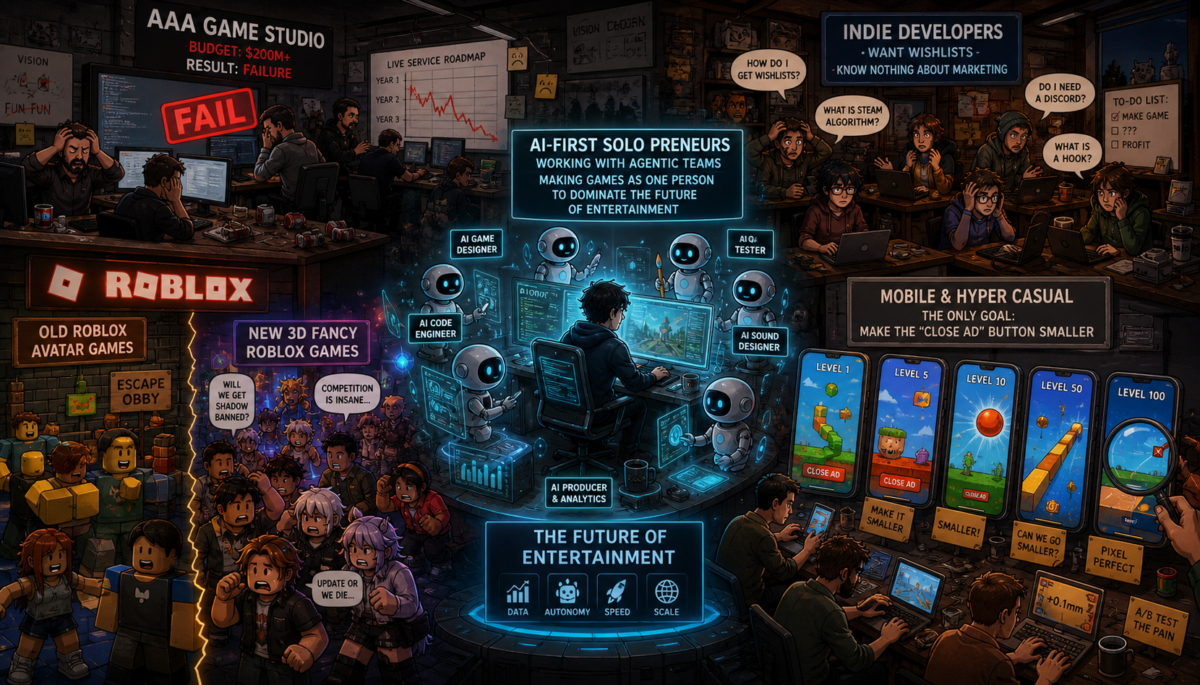
The different tribes of game development, enumerated previously as mobile-first, AAA, Roblox, AI-first, and “wishlist-me-on-Steam” have all decided to just be friends and have stopped seeing each other.
There is now a mad race for each of them to succeed in a way that makes their exes jealous.
Mobile-first is going to be the first to fall in this race. It is a juggernaut of revenue that competes with your line number at the DMV. Free-to-play mobile games with ads and microtransactions have lost their mindshare and have turned into the value aisle of magnetic mini-board games you can buy at the gas station. What you do on your phone now is just tap to fill time because you are bored, or you need to fill five minutes with “not thinking.”
AAA is just done. Everyone is settling for fewer and fewer franchises and fewer and fewer releases of those franchises. We are now at the spot where there are five top ten companies. There are not even ten of them left anymore.
Roblox is going to be doing its own thing and will continue to evolve. Based on the content and the platform, I am going to tell you in the future why it will be eaten by AI-first.
Whaddabout “wishlist-me-on-Steam?”
Oh my heart… I cannot pour the words on the page of the hundreds of thousands of people who have flocked to Gabe’s ego-maker… This massive pit of content that consumes the greatest and best of everyone’s games and turns their shining jewels of beauty into slowly digested 0s and 1s like some kind of Seattle-based Sarlacc pit. Your games, except for ten every month, will go there to die, for the low low price of 100 dollars of your rent budget. I am so sorry. I weep for all of you. Actually, not all of you. I weep for all but 10 of you. 10 people will break out, make some money, post how easy it was, and start a fund out of guilt for their success to fund two, maybe three more games. I don’t weep for those people. They have stopped returning my phone calls, and presumably yours, too.
So what the hell does any of this have to do with AI?
It is like the day the carriers decided that they hated running a games business. They burned it to the ground and left a fertile crop of soil behind for Apple and Google to come and plant a fresh crop of clickable links in a store for downloads and revenue.
These people are running a losing race because they are doubling down instead of trying to approach the platform orthogonally. If you need an example of that, and you are not paying attention to little things like “The most important tech headline of the decade”, then let me explain it to you slowly using very small words.
Apple just rebooted itself. Tim Cook stepped down, and the people who make physical things just got the keys to the car.
I heard a great 20-minute explanation about why Apple is going all-in on the hardware layer for AI, and it is precisely why AI games will win.
I am not going to put a two-page story about why Minecraft’s first-night experience is so fucking good and why brains like new games and new genres. Suffice it to say that there are chemical reasons that new patterns and new play styles are intellectually nourishing.
You will have a pile of those coming out of the indie Steam space, but the only way you will find them is if those people decided to kiss the ring of Marketing, and fork over some time and cash and thought process to making their product visible to more than you and your mom. Also, most indie game developers hate marketing because marketing is why there was a big new John Madden game this year, and they had to skip Thanksgiving to make sure it got done for Christmas, and guess what? The developers got let go anyway.
There are more tragic reasons why indie game developers hate marketing, and that is another two-page rant I am not going to get into.
On the basis of everyone abdicating their ability to win at scale, there is going to be a huge leadership vacuum for new things. It is going to be split down the middle like King Solomon’s baby between AI and Roblox. Roblox is desperately trying to grow up and make itself appealing to “I grew up with Roblox” people who are now thinking about things like “families” and “jobs.”
Aaaand they have activated their own trap card… They are leaning in on 3D fidelity and graphics because why wouldn’t they? And that arms race has already been run and is going to be part of their undoing.
The low-fidelity end of their product is what gave it the wide swath of kiddie eyeballs and is sufficiently good for games. They are going to incentivize all of their “developers” to upgrade and move to a more complicated high-fidelity platform. And all of those people, with a David Baszucki “all of your revenue” gun pointed squarely at their forehead, will jump as high and as often as he likes, even if it means they will have to work harder for less money because it is… checks notes… strategic.
So what does that leave?
Those smug little AI-first a-holes filling in the “Plant A Garden” old platform gaps with their slop, along with every other “release a new game every ten days” platform they have spread their content to. It will fill every nook and every cranny that it can. No one will compete because 10 days of agentic output from six Mac minis sitting on Mom’s old piano in the basement is a force of nature that a team of six developers anywhere in the world cannot compete with.
Admittedly, I only have the one Mac mini right now, but that is the racehorse I would bet on. And the biggest fucking company in the world just made that bet first.
As a result of everyone in the race stopping to tie their shoe lace, or take a dump, or probably both at the same time, the AI people are going to swagger over the finish line in a race that people have tried to run and gotten tired and fallen down.
They are going to release wave after wave of AI content in a world that refused to call a Starbucks Cup in Game of Thrones “slop”, because when the content is good enough, everything is forgiven. Their games no longer have six fingers, two of which were middle fingers, by the way, and based on the ease of creation and the minuscule volume of machinery needed, they are going to succeed just by showing up.
So I am going to go all-in on AI games creation and all-in on AI games enjoyment.
And you know what?
I am absolutely right!
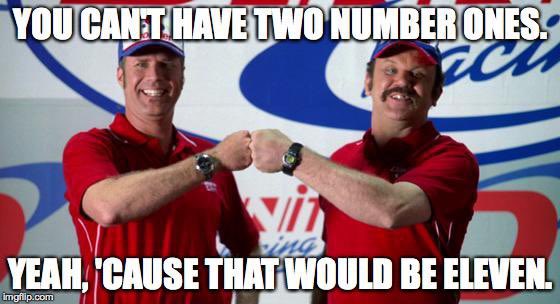
Hello everyone, happy Monday!
I have enough things to write about that I want to give you a summary. No, this is not an excuse to pour my brain emanations into AI. I am just gridlocked right now on topics because I don’t know what you, gentle reader, care about.
I am going to put this on the socials and see if I get enough people DMing me, posting to the threads, or channeling crystal-powered positive energy through the seventh dimension to give me guidance on priority.
Here are the topics. I will number them for ease of identification:
Please ignore the last one; I am not sure how it ended up on my monitor.
This represents three months of blog writing, and all of it feels important to me.
And it was the great Ricky Bobby who said: “You can’t have two number ones, then you would be number eleven.”
The purist in me suggests I should have waited until there were eleven things on this list. At that point, the joke would be pretty old, and I want your feedback today, not in mid-June when you are all off LinkedIn and doing vacation things.
Thank you for helping to shape my brain leakings.

Hello everyone. It is time for another episode of “you know what rilly makes me angerys?”
This is the streaming edition because Netflix is raising its streaming rates. The last time a streaming company raised its rates on me, I announced to the family that we are considering cancelling the service, and by the time I was done saying that out loud, I was finished filling out the unsubscribe box on HBO MAX.
My stated reason for quitting: I am tired of watching James Gunn getting high off his own product.
As a piece of advice: I would not recommend telling customers that you are raising your rates right around the time you shit the bed on your content.
I will return to HBO at some point in the future. I am expecting it to be a short stint where I tell everyone in the family they have 30 days to binge the shit out of whatever it is they want, and then we will turn off the subscription again.
Netflix is different, but only slightly. They did not deliver a massively disappointing ending for one of their anchor franchises. Still, they are also not producing new hits at a pace that can sustain a premium subscription fee.
I went on a walk down memory lane past Warrior Nun, 1889, Lost In Space reboot, and so many other amazing shows.
They used to make many more content bets, which justified the monthly cost. As they raise the monthly fee, I am going to sit down and evaluate it on its merits. And here is where it gets challenging. The bean counters over at most of these streaming services have seen the early numbers from ad-supported tiers, and to be blunt, they likey. It means that they are willing to push the content cost north with the belief that some percentage will convert to a lower base price due to… checks notes… Doritos. Or Skyrizi.
There are insufficient subscribers out there on principle to demand “give me ad-free streaming television or give me death!”
The people on the other end of that ultimatum already put the gun barrel to the forehead of Applebee’s. They started to count to three and pulled the trigger at two. We know who wins in that game, and it is not Jimmy Customer.
A few Hollywood observers have noted that subscription fees are now capped. There is less growth in overall streaming services. It is now Thunderdome. Two Network Enter! One Network Leave!
Everyone is okay with this state of affairs because they each believe that they will be the last network standing.
I don’t love this. I want to have three or four of these subscriptions active, and their price is rising. I am wondering where the break point is for diminishing returns.
It makes me miss the days of bundled cable. We tried so hard to escape the world of “1800 channels that nobody wants to watch,” only to discover that everyone suddenly now believes they are the One True Channel.
Well, everyone except Peacock. I pay two bucks a month for ad-supported Peacock. You can get that kind of deal if you wait for a black friday sale to sign up. There is barely enough stuff on Peacock to make me angry about watching ads or paying just a tiny fee.
The real loser here is Paramount Plus today. I paid for that for a few months to watch a few specific shows and then turned it off. It is a dangerous thing for us as customers to get used to turning off our streaming services.
And now we can stick the landing.
There is a company that is offering one-stop payment services for streaming. Amazon Prime is looking likelier and likelier as my one-stop shop to sign up for premium services, with the understanding that I am about to start turning these things on and off like I am some kind of sugar-addled toddler who just discovered light switches.
It is likely to me that this is going to be the year that I turn into Tommy The Toddler Toggler with my streaming subscription services, and I am going to rehome the majority of my services to Amazon Prime Video.
I think that we are going to see a lot of customers follow this path in the next few years.
I don’t love it. At the same time, there is a certain inevitability to it.
I am going to test this out in the fall when we finally binge a bunch of HBO stuff. The shoe might fit, and fit comfortably at that.
This is going to come at a bad time for streaming businesses, which are under considerable pressure from all kinds of other things. AI. Unions. James Gunn’s gigantic ego.
Something is going to give. Our good buddy Jeff Bezos is going to make some short-term money off of this, but then what?
There might be reasons I am foreshadowing here just a little.