Categories
Monocategorized

Meebollionaires

There is a bunch of crap in the news right now about how Instagram is super horrible and everything. A week before that, I think everyone was still super excited about how it was a rags-to-riches story from an overnight success by a pair of stalwart product developers who stumbled into a Zuck-quisition.

I actually hated Instagram from the very beginning, but not for this reason.

I hated Instagram because of the death of meebo.

Let’s back the truck up for a moment because I am sure you are confused.

What the hell does meebo have to do with anything?

What the hell is meebo anyway?

Meebo was a hammer in search of nails. I was one of those nails, as a software developer `spending time as a consultant inside of a hardware company. Their firewalls were for serious and when I wanted to be all up in people’s Socials, meebo was a great tool that brought all the power of instant messaging into the browser.

I also think it is where the Instagram founding team cut their teeth on making great products—and Instagram was acquired because it was a great product.

Meebo was also a great product. It just had a very limited use case and certainly not one that would merit spending significant money on. It is a great example of how fucking hard it really is to make a successful venture-scale business because at the end of the day they had the majority of what they needed to be successful, plus or minus a few million customers willing to spend “not zero” dollars.

It is hard to write about this because I really loved using meebo. They did so many clever things. They were so smart they even put a string into the bottom of their web page as a breadcrumb for recruiting. If you were interested enough in their product to use the “view as source” button in your browser, they put an email address in there for recruiting purposes. How clever is that?

The reason I want to talk about meebo, aside from the obvious need to grieve its loss, is how it applies to software development and success today.

I am in the process of iterating my way towards an MVP. I talked about it a few weeks ago. I am in the process of going through all of the cosmetic UI/UX things that are needed before I trot this product out in front of a limited test audience.

As we have iterated our way towards acceptability, I have found myself looking for an appropriate lens to describe this process.

I have settled on the need for this experience to feel as good as I felt when I was using meebo.

I am pretty sure that helps almost nobody to understand what I am looking for in my MVP.

So I have attempted to figure out what that looks like for a web application and how to express that as a set of PWA rules.

Here is where I have so far:

  1. Every button must have a clear purpose. If you do not need to press it when you are a new user, you probably do not need to see it. Disable it at a minimum, hide it more ideally. The less you need to teach your new customer, the better off you will be. If you have 1 page of data and you have buttons to take you to page (n – 1) or page (n + 1) you should probably hide them at the start, no one should click on a button that takes you from page 1 to page 1.
  2. Pixel perfection is a minimum. If you have multiple tabs of windows, or multiple panes of data, make sure they line up perfectly every time. If you have a window that is even a single pixel off when you are tabbing front and back between windows, you are doing something horribly wrong. Line up the tops and bottoms of all of your windows and change those sizes at your own peril.
  3. Concurrently resize as few things as possible. If you have two columns of data and you are resizing the window, do not resize both at the same time. Keep one of them consistent and resize its width on your own.
  4. Minimize a column on mobile if it is unnecessary, and add a button to slide it in and slide it out as needed.
  5. All of your operations need to possess symmetry. If you have a button to set the number of entries per page to 50 from 10, make sure you can set it back to 10 from 50 if you want to. If you are starting with 25 entries on that page, and you can set it to 10 or 50, but not return it to 25 entries, you should probably remove 25 as the default starting value or add it as an option to your pagination.
  6. Put something interesting and helpful in your tooltips. I know you don’t get the benefit of mouse-overs on mobile devices. You can do tooltips on a long press event if you really need it.
  7. Resize the shit out of your window. When I look at an application now, I drag it around the screen like a crazy person. Make sure the resizing looks really good in realtime and that you don’t have some screwy resizing code that winds up breaking your screens.
  8. Be ruthless in eliminating scrollbars. Keep them internally consistent. There are expensive books on UI/UX that tell you to avoid horizontal scrollbars—I do not know that there are enough books telling you to make sure you are controlling your vertical scrollbars. If you have too many scrollbars, your application will feel awful. I especially despise the scrollbar on the absolute right of the browser, indicating there is more for the whole page. You are better served by dynamic pagination or by keeping scrollbars inside your content panes. When I see three scrollbars on the screen, I get filled with furious outrage that exceeds the searing hot intensity of a thousand suns.

I apologize if I have triggered any design people with my eight random angry rules of designeyness. They come from a good place—my desire to make an application that feels good to use.

I want to make sure that my MVP feels as good to customers as meebo felt to me.

If that also means that I sell my next startup to the Zuck-inator for umpteen jillion dollars, hey that would also be okay by me.

Thank you for reading along! I apologize I am not able to show off my interesting little tool for solving tedious creativity yet. It is giving me some anxiety that it is not quite ready for a select few users to kick the tires. I am hoping that it will be ready in Nov-tober. I am supremely confident I can continue to regale you with interesting stories that have nothing to do with my MVP product until then.

Categories
Monocategorized

Meaningful Play

I am going to continue to pop the clutch over the next few weeks and talk about a few different random things. You might get the sense that I am stalling in the middle of telling a significant story. You might be correct. Please accept my apology and try to enjoy the side-quest we are now on.

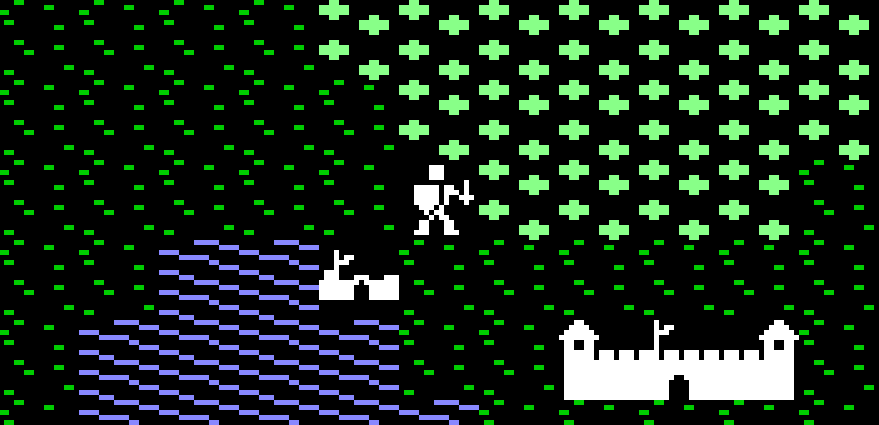
I was in three conversations this week where we talked about meaningful games, purpose, and transformational play experiences. There is no doubt in my mind that Ultima IV: Quest of the Avatar was the most transformational game I ever played. I think it is probably unparalleled even today for its depth and sophistication. If I am wrong, please let me know. I am happy to reschedule a few afternoons of chasing kids off of my lawn to enjoy transformational play.

I am going to attempt to summarize what I think is so special about this game.

Character Creation

The standard character generation for most games around this time consisted of rolling and  re-rolling (and re-re-rolling) stats for your starting adventurers. Many roleplaying games inherited the pencil and paper re-rolling methods.

Ultima IV had you fill out a virtue questionnaire. Your answers took you down a decision tree to pick the virtue that you most identify with. For a game that is not about the stats, or the min-maxing, I am somewhat conflicted when I say that you want to pick Humility, and start off with the shepherd. Otherwise when you do get around to recruiting poor Katrina of Magincia you will have a real hard time leveling her up. If you wind up with the shepherd, you will be able to level quickly since the lead character gets 100 experience points for each “quest item” you find in the game.

Character Dialog

I love the dialog system in Ultima IV. Every NPC has a set of keywords that they wait for. Some people will tell you about the dungeon stones. Some people will tell you about the mantras. Some people in the game will sit there and wait until you learn from someone that you need to talk to this person about the skull, or the wheel, or even one of the spells that is not in the game’s documentation.

I really like that you need to understand who to talk to and what to ask them. This kicks the pants off of choosing option A or option B in the dialog tree. I refer to this as “meta-knowledge” in games. The knowledge that you need to have, as the player, which is not represented in the game.

Party Progression

You have eight slots for characters and there are seven non-player characters scattered throughout the world who will join you. You get to add a character to the party each time you level up. If you are not yet able to add them, they at least will tell you that there will come a point that “I would be honored to join thee”. It is nice to focus on a few characters when you begin the game, and be able to layer in additional characters over time.

The Virtue System

I almost wanted to talk about this first, but the most important part about Ultima IV is the virtue system. The point of the game is not to slay a specific dragon or to take down a powerful wizard. The point of the game is to strive to be elevated to the status of “Avatar” through eight virtues of enlightenment, which are Honor, Humility, Honesty, Sacrifice, Spirituality, Valor, Compassion, and Justice.

Everything in the game rolls up into these eight virtues.

There are eight shrines to meditate on each virtue. There are eight cities, each of which has a virtue as their raison d’etre. Each member of your party represents a class that is associated with one of these virtues. There are eight dungeons, which are generally the homes for the eight stones you need.

The best part about it is that there is a set of eight numbers in the game that tracks your status in these virtues.

If you attack evil monsters, your valor goes up.

If you pay the blind reagent vendor correctly, your honesty goes up.

If you kill non-evil monsters, your compassion goes down.

There are very clear actions throughout the game to increase all of these virtues to the level they need to be. In order to win the game, you actually have to do these things instead of running around town being a giant murder hobo. This was probably the most impactful part of the game because it was so different. 

I do not think there is a game out there today that captures what the virtue system did in Ultima IV.

The Pretty Colors

The next really interesting thing about the virtue system is that they were all color coded. There are three “principals” in the game that represent Truth, Love and Courage. Courage is red, as is valor. Each virtue can be broken down into one, two, or even three principles, and the color of its stone matches the principles it stands for. 

The white stone for Spirituality, for example, shows it is the embodiment of all three principles.

The orange stone for Sacrifice shows it is the embodiment of Love (yellow) and Courage (red).

I played this game early enough in my life that this is how I learned about primary and secondary colors. My mind was totally blown!

The Window Dressing

Let’s set aside that Ultima games meant cool cloth maps, funky stones, and necklaces.

The spell book was incomplete and some of the spells needed to be learned by tracking down people in the game to ask them questions.

The shrines in the game gave you visions that correspond to runic letters to spell out a word that you needed to win the game.

There were a series of magic gates that took you from city to city based on the moon cycle. The moon cycle was also needed to enter specific shrines and find specific items.

Not all of the magic reagents to cast spells could be bought. Some of them could only be found at midnight in special places on the map.

There were optional items like the Skull of Mondain, and the Wheel of the HMS Cape that you could find and use at various points. 

If you used the Skull at the wrong place, you would lose all of your virtue. If you used it at the mouth of the abyss, it would destroy it.

If you learned the coordinates of the Wheel of the HMS Cape, you could use it to beef up your ship.

I don’t even know if I can remember all of the cool things that you can find in the game—Hot air balloon, mystic armor, the list goes on.

The End Game (spoilers question mark?)

After all of the cool things you need to learn and understand, almost none of which have to do with combat mechanics, the last thing you need to do is to enter into the final dungeon that is the holding place for a magic book of virtue.

You collect the book—and you win the game.

This was so vastly different from so many games with an end-boss who spends most of their time sitting in a room doing very much nothing.

When you do complete the game, it does one more thing that I really appreciated.

You get a little “chef’s kiss” narrative that amounts to Bill and Ted’s wisdom to “be excellent to each other”.

The boundless knowledge of the Codex of Ultimate Wisdom is revealed unto thee. The voice says: 'Thou has proven thyself to be truly good in nature. Thou must know that the quest to become an Avatar is the endless quest of a lifetime. Avatarhood is a living gift. It must always and forever be nurtured to flourish. For if thou dost stray from the paths of virtue, thy way may be lost forever. Return now unto thine own world. Live there as an example to thy people, as our memory of thy gallant deeds serves us.

Some pretty deep stuff!

I appreciate a good twist ending as much as the next person. Bard’s Tale II and Diablo, I am looking at you.

I do not know that any other game out there has moved me so deeply. I cannot help but wonder why this game is the exception, and not the norm.

What other games have you played that weave such a rich, profound personal tapestry?

PS: This game is available as a free download on GOG.com.

Categories
Monocategorized

Joe the Elf

I think I have said before that making games is hard. I know there are many people out there who love playing games and think that will translate into making games. You will never find a group of people who will work harder for less money than game developers. The amount of work that goes into a great experience is hard to fathom until you have gotten to the 90% mark. Quite often, at that point, you have just begun to ship your product.

One of the marks of a great game for me is good storytelling. I appreciate good storytelling in games and in movies. I would love to do more storytelling in games. I have at least one person who tells me I should not be thinking about making games for my storytelling, that I should go and write books. I try not to be hurt by the aforementioned statement. I also run a tabletop game off and on and I get told by some of the players over the decades of being a tabletop game master that I should write books. When they say it, I actually feel humbled by their praise. Go figure.

I have a Sunday project I have been working on for a while now. It originally started in 1997 as a tool I built for myself for my own tabletop campaign. I wrote a clever tool in C++ and I was a test audience of one off and on for about five years. I dusted off the codebase in March and ported it to a web service. It was somewhat fun to move my early project into “ThE cLoUd”.

Somewhat ironically, I suspended my tabletop game to give myself some time to build tools to help make my tabletop games more interesting. That is probably the most programmer-ey thing in the world.

Over the past few months I have had someone helping me build an MVP out of my little tool. It is nearly complete with a few tweaks here and there. I am almost at the point where I can test it out as a Progressive Web App (PWA). This means it is a website that has application functionality and it is usable on the phone, and on the browser.

I think this is important for a few reasons.

The first is that it means I can set up some kind of revenue stream around this without having to pay Tim Apple or Larry SearchyPants a 30% tax. It also means I can update my project and release a new version without needing to wait 12 to 100 hours depending how close it is to Christmas.

Setting aside the pain of making new things, and the excessive tax, I think that making PWAs is the future. We are about to see a resurgence of people experimenting in the open web for a variety of reasons and I am super excited about that. I understand “Does It Scale?” is easier to answer if you can point at a link to the Platform Thirty Percent Tax Store. The tides are turning and being able to build and deploy quickly to the web will be a really important thing for the coming five years.

I am going to stop talking about my excitement for the un-App-ening that is happening. It has nothing to do with what I want to talk about today.

Today I want to talk about Joe the Elf.

Running a tabletop game is hard. It is almost as hard as making games sometimes. I will confess I am one of those “make shit up” kind of game masters.

I make the world into a tapestry, and I have a series of agents acting in the world behind the scenes.

I do not care if the players stay on the rails of the story. There isn’t one. I give them hints and teasers to stuff happening in different places at different times. I have played in tabletop games where the game master has tried to take control of the story and force the players into the tavern, or make them enter the dungeon. It is tedious and frustrating when that happens because it breaks the fourth wall.

I do my best to do things to keep the fourth wall intact for players. You can look up the fourth wall if you like. Googles has buttons for you to click on without my lovely links. 

It is hard to keep the fourth wall intact when you are making shit up. If you are adding random things to the game world on the fly, you might find yourself in a situation where you have the players coming for a stop at a roadside tavern, and inside sitting at a table near the hearth are five elves engaged in deep conversation.

I generally add window dressing to the campaign with elements like this. Of course, invariably you have that player who asks you two questions:

“What is the name of this tavern”?

And

“I introduce myself to the elves and ask for their names”.

This can be a difficult moment. It is one thing to quickly reply “This is the Roasted Apple Tavern”.

The next question gets more difficult.

“The elves introduce themselves as Gilthaniar GoldBow, Shaellisti Oakleaf, and uh…”

Here is where you can hear the shattering of the fourth wall.

You have so much spontaneity in storytelling and so much stuff that matters in the back of your head you have hit a momentary mental stack overflow.

At this point you gesture lamely and add:

“Joe the Elf”.

If you were running your tabletop game on Yelp you just lost two stars.

Naming five elven NPCs in realtime is hard.

Unfortunately, it is sometimes very important.

This ties into game development here. Sometimes you will find “Joe The Elf” manifested into game development. You have too many cities, taverns, and agents in your game to name effectively.

I have decided to label this problem as Tedious Creativity.

Tedious Creativity is the need to deliver multiple creations that are thematically sensible over a short window of time.

Fortunately for us, computers are very good tools for helping us solve this problem. I started monkeying around with my own solution decades ago.

I am going to be shipping that as a product for game masters Very Soon™.

If you are running a tabletop game and are interested in kicking the tires on a tool to help solve Tedious Creativity, drop me a private note on any of the socials.

I would love to give you early access in the coming weeks and get your thoughts and feedback!

Categories
Monocategorized

It is Spotify all the way down

With deadlines, back-to-school, and poor local air quality, I was unable to write anything significant last week. I apologize. I am hopefully more consistent going forward.

Speaking of consistency, I want to continue talking about Spotify. Spotify is one of those businesses you expected to help bring about a beautiful universe for all creators. Instead, people make jokes about the money they make from the platform and it is so bad that artists have intermittently attempted to create their own competitive service.

I should add that I use Spotify as a free customer. I do so out of spite. My Google phone will let me use YouTube in the background to stream music randomly, and constantly reminds me that I can pay Google extra money for a service that a music platform gives me for free. Considering how many business gmail accounts I use, I am insulted that I can’t get one complimentary premium YouTube music account to let me stream music using software provided to me by the people who made the operating system.

I digress.

So how can we get from Spotify-as-a-deeper-circle-of-hell to Spotify-as-a-force-for-good for creators?

There is a path.

It involves moneys, and giving said moneys to the people who create the content. I don’t know who this guy is, but for that net worth from Spotify, I feel obligated to attend his first concert.

One of the fun parts of being involved in high tech over the years is meeting people with amazing ideas.

One of the most interesting ideas I have seen is the notion of the “sliding royalty”. Creators should have some means of saying “I wish to dedicate X% of my income to promotion, via the host platform, to increase discovery” and being able to modify that in real time.

I hardly think that artists like Miley Cyrus need Spotify for discovery purposes. Miley Cyrus and artists like her should command a generous revenue share from them.

Implementing a sliding royalty that can be used by artists to decide on how much to commit to marketing their content vs profiting from it is a good first step towards fixing this problem.

Another idea here would be to modify the revenue share based on the source. For example, I am a free Spotify listener. I do not know the unit economics of the ads I hear. It makes sense that the advertising revenue be largely owned by the platform. I dislike the notion of paying Spotify knowing that the revenue that comes from my pocket will largely go to “Not Miley Cyrus”. For the record I don’t really listen to Miley Cyrus, but I think you get the idea.

If Nissan Pathfinder wants to give Spotify some money to try to persuade me to buy a Nissan Pathfinder, I am fine with the ad sales team at Spotify making a generous portion of cheddar. To be fair, the more ads I hear from a particular company while listening to music, the more irritated I get with the brand being advertised. In this particular case I am talking about Nissan Pathfinder because the amount of Nissan Pathfinder ads I get makes me very much want to never own a Nissan Pathfinder.

That is somewhat beside the point and perhaps a conversation for another day.

The big point is that Spotify ought to try to fix this problem and start experimenting with revenue models. I would be happy to give them some of my money if I thought it was going to the right people—namely the creators.

They could put in some tools to work with creators to give them control over royalties and promotion.

They could even add in controls for superfans, who wish to support specific artists, Patreon style. If you had a 30 dollar per month offering that included a monthly digital exclusive package, and perhaps an annual physical goods drop that included VIP t-shirts and (gasp!) Compact Discs, there are people willing to give you their hard earned moneys.

I guess by now you might realize that I am not just crapping on Spotify. I am crapping on just about every platform company out there. I have directly offered the sliding royalty idea to just about every major platform out there.

They have all shrugged and gone back to their existing roadmaps because ensuring that the value chain works for everyone doesn’t help them hit their OKRs.

Some famous person somewhere said “Content is King”. I believe that to be true. I am excited that there are companies out there pushing for platform-level change. This includes things like the Epic Games lawsuit against Apple, and Tim Sweeney’s statements about committing to dropping exclusives if Steam matches their revenue share.

We are on an evolutionary path towards an increased revenue share for people who make things that other people love. I watch companies struggle against it and try to furiously stuff as much moneys in their pockets as possible while they can.

I am hopeful that this touches a nerve for a platform decision maker somewhere, and that they will wake up tomorrow and look at themselves in the mirror REAL HARD and ask “at what point did I turn into Spotify?”

Thank you again for reading along. I apologize for the gap in ranting last week. I will do my best to keep to my schedule going forward.

Categories
Monocategorized

Let them eat dogfood

One of my guilty pleasures is to be a part of a raid team in World of Warcraft. I have played the game since The Burning Crusade, which launched in 2007.

When I purchased the game, I recall seeing that there were three boxes beside each other each with a different sticker. The first sticker said “3 million copies sold!”. The second sticker said “4 millions copies sold!”. The third said “5 million copies sold!”. I was greatly amused that they were selling so fast that they could not print the stickers fast enough.

World of Warcraft is a very popular game, and it dominates the MMO genre. I do not really think that is a good Massively Multiplayer Online game (MMO). I recall having a conversation with David Maynard years before where I talked about Massively Singleplayer Online games. I think he can still verify that I used this term before Will Wright tried to make it popular. I believe WoW is a very good MSO, with some multiplayer elements.

We can quibble later about what is and what isn’t an MMO. I have been watching for innovation in the genre without any reward for that effort for many many years.

A few weeks ago I made a note to write an angry rant about a quest in the most recent zone added to WoW; A quest called “Think of the Critters”.

I am somewhat amused to see there is a change in the patch notes from last week:

Quests

  • Resolved an issue with Gromits during the “Think of the Critters” quest in Korthia. Hungry Gromits now anxiously await your delicious treats!

You can find some interesting notes on this quest at the following link.

I think that they made a directionally positive change on this quest.

I still think it is one of the worst quests created in the game.

It has me asking myself some very profound questions.

How did this quest get through any kind of QA?

Who created this quest?

And most importantly to me:

Did the person who created this quest ever play this game… ever?

I can generally feel the invisible hand of designers in many of the games I play and online products I use.

There are a few quests in the most recent expansion that left me feeling a little frustrated, and a few systems that are so incredibly obtuse that it made me wonder what they were attempting to do.

This one quest has so many different stages to it and uses so many friction-inducing mechanics that it stands out as the worst of the crop. It has no peer for the amount of steps to take, the complexity of mechanics, and the amount of failure per attempt. It sounds like they addressed the failure rate (the last part of the quest) in an attempt to address player’s issues with it.

The good news is that these quests are randomly generated. That means you will not get this quest every day.

The Korthia daily quests also have random rewards. This has been frustrating because many of these quests drop uninteresting rewards. I have had days where I get 100% of them dropping Anima versus the new currency that matters. That is a silver lining here because if it has bad rewards it means it is one less quest for me to pick up on my pursuit of collecting currency items for the zone. The random rewards here are an anti-pattern that helps me cull pointless activity out of my day in a way that ought to make data analysts at Blizzard afraid that I might self-select into the churn bucket.

So why am I raging about this terrible quest?

I love online games and playing with other people.

WoW has a very strong community and has a lot of great content. You can set aside that the current story tends to focus on how you, as “The Champion”, are generally chosen to save the world (much like everyone else logged in around you). It is the clear king-of-the-hill of the MMO genre.

I have played many betas and early launches for MMOs over the years. It is why I took a job making games. Twenty years ago I sat down and crafted a half a dozen cool systems I would love to see built that would take us from MMO 1.0 into MMO 2.0.

Unfortunately everyone trying to compete in this space has to replicate MMO 1.0, or at least at a minimum try to make MMO 1.1 due to WoW.

So why do I still play WoW?

I still play WoW because I want to see how it ends.

This game is a technical marvel in many ways, and a design marvel in many others. People debate “the end of WoW” quite frequently. The people that have been in the industry the longest or have some of the best insights have generally said “the only thing that will kill WoW is WoW itself”.

This ridiculous critter quest is one of the positive proof points that we may be nearing the end of an era.

Categories
Monocategorized

Taking the edge off of cutting edge

I had an interesting conversation based on last week’s article about the meta-worse. Someone asked me to review a very interesting technical demo and see if I could offer them some assistance bringing it to market.

I was quite impressed with the technology and feel like it has some great potential. It is extremely early augmented reality technology. The only thing I could reasonably do is add more conversations about technology to an already technology-rich environment.

One of my biggest problems is that I am generally two to seven years too early professionally. I start making products and platforms way before someone with better investor relationships writes “gib munnies” on a napkin and slides it to his friend over breakfast somewhere near Sand Hill Road. I also do not have the phone number of the person who can give me a Hasbro board game license. These are things I am okay with. I accept that I did not yet sell a company for a hunnert million dollars in order to raise another five million dollars. We can obsess over the biases at work there at a later date.

What I did do is outline where these fine technologists should look in order to get their product better positioned to be successful.

Let’s rewind twenty years or so.

When you had really cool technology prototypes there was a high likelihood you could add some goblins or some spaceships and start marketing your gimmicky gadget to the Hardcore Gamer. Does it have cool spells? Are there amazing laser blasts? Someone will throw a couple hundred dollars at that and talk about it during their tabletop gaming night over pizzas and Jolt cola.

In looking at their technology demo, and thinking about what I would do in their shoes, I thought about my first failed attempt to raise venture capital in the early-to-mid 2000s.

I had some reasonable success in the early 2000s making little mobile games for feature phones. The more games I worked on, and the more phones that were released, the more it was becoming clear to me that there was going to be a transition to a higher-end phone that would be a genre buster. Keep in mind this is 2004 to 2005 or so.

I reasoned that we will probably see this device in a few years and that there was an opportunity to create franchises that players would love if we can get someone to co-fund the development while we were generating revenues off of the existing feature phones. That is right. I was trying to “pivot”. I heard that is what all the cool kids are doing.

The idea was reasonably solid. The iPhone showed up pretty much around the exact time that I thought it would. Unfortunately, I raised zero million dollars because no one believes Al Gore invented the internet. I am okay with that comparison because he has really nice hair.

I told this woeful tale because there were some interesting shifts in the marketplace happening and I was not really processing them fully.

The consumer barriers for owning fancy gaming hardware were falling and the price for phones was on a downward trend. Admittedly it leaped up when Steve Jobs started peddling his touchable surfaces, but if you inflation-adjusted that a little and squinted it at it, somehow people felt that it was a cheap-enough price that everyone should now go out and buy one. The smartphone revolution (evolution? iVolution? whatever) had arrived.

There were a few other things happening at the same time that are noteworthy.

The first is the creation and subsequent demise of the casual games downloadable business. Companies like Popcap and Pogo created awesome little casual games (“Easy To Learn, Difficult To Master!”) that became exceptionally popular. These were pretty easy targets to migrate to cheap feature phones and eventually to smart phones. The casual games downloadable marketplace subsequently ate itself due to the tulip-bulb phenomenon. Everyone released a dozen hidden-object games and stopped making every other genre. It is ironic that they could not see the problem that was created by shipping too many hidden object games.

The second is that these games became very popular on mobile.

I was not the only person to realize that there was awesome stuff happening in the world of mobile. I was also not the only person to come up with a terrible plan to Make Money Fast.

Let’s talk about the first seven years of instant overnight sensation Rovio.

Rovio was a company founded by former Digital Chocolate alumni. The word is finnish for “bonfire”. I will let other historians provide context for why they needed to start a bonfire after leaving Digital Chocolate—it is not my story to tell.

They created the company to create seriously cool stories and deep experiences for the mobile audience. They published deeply interesting, super serious IPs like “Darkest Fear” and attempted to engage core gamers on mobile devices. This is pretty much the same playbook I was attempting to use, but I was several million dollars less successful in raising money for it.

I had chances to meet the leadership from Rovio over the ensuing years as they pivoted repeatedly through fifty-ish games and wandered around in the wilderness until they threw one last thing at the audiences.

Welcome to Angry Birds, and one of the first genre-defining experiences for the smartphone era.

So what does any of this have to do with anything?

Let’s go back to that technology demo I was talking about. Without getting into too many details, it showed off some elements you might expect to find in a really cool RTS game. The problem with their demo was that we are many years away from the last successful RTS game coming to stores near you. You could make the argument that Clash of Clans and its subsequent Nanostars Siege derived variant game are essentially distilled from the core RTS mechanics.

They actually share something in common with Angry Birds and also with recent mass media sensations like Among Us, and to a lesser extent, Fortnite.

If you are paying attention to the trends in gaming and also in gaming investment, you might find that there are some strong correlations that are worth thinking about.

The first is that you are seeing more and more funding available for games that are midcore-to-casual. In the extreme case, you could go the hyper-casual route and essentially just zero out your art budget (As A Hyper-Casual Game Developer I Will Buy All My Assets For Ten Dollars In The Unity Store), but that does not endear you to creating a sustainable defensible business because all of the hyper-casual publishers are ultra-cannibalizing their own market to death.

The advice I gave to these really swell technologists is to go back to the drawing board with their technology demo and to revamp it to take into account the consumer aesthetics that will attract mass-market attention and subsequently investment dollars.

If you look at the aesthetics of Angry Birds, Among Us, and to a lesser extent Fortnite and Clash Royale, you will notice they do not go deep into high poly counts or edgy, real-life, 3d graphics.

In order to succeed in the games marketplace today with new technology, you need to pair it with an aesthetic that delights mass markets, which will also be more likely to attract investor dollars.

I suggested they take a page from these games and reduce their characters to simple blobs and focus on finding a game designer who will craft an experience that accentuates the technology’s benefit. Angry Birds did this quite well with touch screens. Among Us did this quite well with group-voice-inspired play.

These games did not require high poly counts to become successes. In fact they were pretty much just shapeless blobs on the screen, which is why I advised that they should consider removing the edges from their prototype characters since they are already on the cutting edge with technology.

It sounds pretty clever doesn’t it? I sure thought so.

If you are in the business of creating mass-market content, I recommend you take a look at your art direction and desired audience.

You might find that you need to remove some edges too.

Categories
Monocategorized

More like… meta-worse

This has been a busy week for a plethora of reasons. A veritable plethora. What a great word. Plethora. While I have been busy with my plethoras, I have also seen a plethora of news recently about the metaverse.

And I want it to stop.

There are lots of people on the hype train for the metaverse and I am not one of them. Actually that is not true. I am probably one of the biggest fans of seeing a metaverse. I tried to pitch stuff to AAA executives a decade ago about the value of players buying and selling to each other and the general reaction was “You cannot sell used bread outside of a bakery.” I nodded and smiled but inside I was either weeping or screaming.

There are a lot of people in the process of building a metaverse, or raising money to build a metaverse, or talking in bigly terms about the value of a metaverse. I want to drill down into what the metaverse is, and if you agree maybe you will smash some social buttons for me and share my big thinkiness with your friends and family.

So what is the metaverse?

If you read popular science fiction, the metaverse is a connected set of worlds owned by different people where players can get junk in world A and carry it into world B. Kind of like going to the mall. You can buy a fancy hat in the fancy hat store, and still get to wear it into the fancy ice cream store. Most content today does not do that. You go to the fancy hat store and buy a fancy hat, you do not get to go to the fancy ice cream store and show off your fancy hat. You can just buy the fancy ice cream and talk about your fancy hat. You probably cannot show a picture you have uploaded of your fancy hat, because most businesses understand TOP  in user generated content. Warning: Please do not look that up on your work machine.

My thesis is that the metaverse generally evolves in a way for virtual world creators to make and sell stuff to people directly. This is important because everyone who wants to build the metaverse is touting this as a part of the sales pitch. You Will Make Money Fast.

The problem here is that most companies chasing this dream today are not actually virtual world creators. The vast majority of them are Spotify.

Do not get me wrong, I use Spotify. Its ads are less invasive than YouTube on The Googles. I hope they offer me six months free sometime to agree to sign up. I do not feel like their “one month free” or “three months free” user incentives are enough—I am willing to watch GEICO ads until they are that desperate for my business.

So metaverse companies are raising venture capital. That means they are doing venture-scale planning which requires mass-market success and billions upon billions of dollars. A founder has got to get paid, right? We do not have enough Zuckerbergs out there for the average venture capitalist’s liking. Certainly not in their existing portfolios, which is why they keep writing checks.

A lot of content creators believe that creating the metaverse is a means to get themselves paid. A lot of people building the metaverse right now are probably saying that and talking about the democratization of content. In truth, they need you to believe that in order to get their application to join the 0.1%. They will use your love of Neal Stephenson’s Snowtrash to beat this point home. Yes, I am being mean to an okay book. Yes, I am also linking it with an affiliate code.

The problem with people raising money to build a metaverse is that they are all going to wind up needing stuff to sell and most of their money is earmarked for other things. There will be some companies that make good-enough tools, and good-enough plumbing, but it is going to cost a lot of money. Some of them will make some neat stuff. Some of them will wind up being a second second life.

My belief is that the best metaverse we could possibly get will be one that comes from a bunch of creators who build connectivity and contracts between their own worlds, one at a time. There are great connectivity tools out there. There is sufficient billing and data storage infrastructure.

Heck, there are even common enough 3d engines that people are using to support sharing object formats between them.

The bleak history of platform-as-something-something-future has not led us to a brighter and rosier future for content creators. Generally it means that the old regime of gatekeepers has a new cohort of gatekeepers to add to the pile of fee collectors between Joe Consumer and Jenny Creator.

Almost everything being announced about the metaverse today is being said by people who are just sticking out their hand and bundling services together because they are friendlier with the average venture capitalist than most content creators.

And this is why I think we are not going to get the metaverse. We will get the meta-worse.

The only reason I am not despairing is that I spent a bunch of money in Fortnite.

Fortnite has been slowly building systems and technology season over season. They added cars. They added airplanes. They added boats. I have marvelled at seeing them building an MMO, isolated system by isolated system, on customer’s dimes without anyone saying anything about it.

They have great brand partners and are helping people make money through their game store and their platform.

Heck, the newest person in line is even going so far as to say that if he is going to take his place with his hand out for a share of money, he is at least going to take out one of the incumbents who wants way more money!

I wear my Free Fortnite hat every day at work. It is among my prized possessions. I think it is awesome that they gave out schwag for the lawsuit of the decade. Tim Sweeny is Person of the Year for me, every year at this point, while he is doing things that massively increase the potential value of being a creator. I think that helping reduce friction for content creators is noble. Of course, I also think that billionaires paying to go to space is noble, so you can probably discount my sense of what is cool by your own filters.

I hope we get a metaverse someday. I am skeptical the current crop of companies chasing this are going to be successful. I believe that the metaverse will emerge from the necessity of exerting margin pressure by IP holders, not by the need to get to an IPO to increase the ROI for investors into venture funds based on the flavor of the month of high tech buzzwords.

Thank you for reading along! I hope my opinion on the future of the metaverse is as interesting as it is entertaining. How often do you see a once and future founder shitting on investment strategies for stuff he wants to get paid to build? If I gave you the lols with my salt bae vibe, you should totes adorbs it on your socials. Thanks. Hashtag gratitude.

Categories
Monocategorized

I Habit Gud

Last week I took a hiatus and put up a “Something something post” that was a link to a friend’s article about looking for a new opportunity in “Not Oregon”. It was ironic because I gave that friend a few reminders about the importance of their writing habit and then used them as cover for not having made enough time. The blood won’t wash off my Lady Macbeth hands.

Habit forming is hard. I started writing with a purpose. Part of the reason I was not able to post the past few weeks was the arrival of a newborn to my family. Another part of the reason I was not able to post yesterday was that I was busy working on the super-secret-sorry-to-vaguebook personal project. More on that soon.

I am investing some belated time to write a few words on habit forming. I saw a great book sprinkled around the offices of an html5 games company I went to visit. I am going to link it here and you should go buy it because it is a great book. I am also adding an affiliate link because I am curious to see if that works. If I descend into urging you to smash the subscribe button, this is where it all began.

Charles Duhigg’s The Power Of Habit

This is an extraordinary book and one of a few I am going to talk about as “transformative” in my career. I am glad I spotted it. I am glad I purchased it.

I have intentionally created a few habits since reading this book.

I think that if you can understand how to create your own habits, and you are in software development, you will find there is a correlation between figuring out how to apply this book to your livelihood and how big of a check you are getting for those services year over year. I do not yet have a fancy lambo to drive around to say I am an undisputed master of collecting and subsequently dispensing dead presidents, but I do okay.

I am going to get back to meatier subjects related to engineering management, product development, and product launches soon.

I apologize I have not had much to offer in the past dozens of days. I will be back to you soon with much to talk about.

Have a great work week and I appreciate all of you for shamelessly clicking on my experimental affiliate link above. I will let you know if it actually works.

If I don’t you can all complain about how cool I was before I got famous.

Categories
Monocategorized

Hire learning

I spend a lot of time trying to help people build teams. That involves lots and lots of hiring.

Most people are solving the wrong problem when they are trying to hire someone. Most people are trying to solve a problem they realized they had yesterday, as opposed to hiring someone who will prevent them from having similar problems tomorrow.

The best way to fix this is to seek “best athlete” candidates instead of “best fit” ones.

Admittedly this is pretty “early team” focused. A lot of people looking for deep domain experience in a particular space may have a good reason to do so. You want to keep your Google shareholders happy if you are Google, and hire a VP of Very Good Search to run your core Very Good Search business. Or if you are in the business of Repairing Critical Body Parts, you will want to find a doctor who is very good at Repairing Critical Body Parts.

The truth is that this is really only true for a fraction of the roles out there. Most companies should be focusing on someone who can learn their surroundings quickly, start making changes and measuring results.

To do that, you really have to focus on one thing: Is the person in front of me sufficiently talented to be successful?

Instead, most companies try to hire people who are the closest fit to what they have in a checklist. A great many people fixate on the shape of the qualifications and it creates a whole lot of problems.

For example, “I need a software developer with 5-7 years of experience in McGuffinSpeke” sometimes is not really what you are looking for, especially if McGuffinSpeke has only been out for 3 years as a language (and yes, this happens a lot).

Over many years of hiring, I have adapted my personal practices towards finding talented people—and I have had some pretty amazing results. I have written it into my own personal playbook and I apply it very effectively into organizations where I work.

Here are some things that I have learned.

1) Stop trying to find the perfect candidate

You should be able to better define the “must have” and “would be nice” for what you need from  your future employees. Quite a bit of the time, people can come in and get comfortable with new tools and new technologies, but it is important to understand if they are capable of doing so. So you should…

2) Establish how fast a candidate can learn

This is a big chunk of what I look for. Oddly, the person who has had several jobs that are 18 months to 3 years in duration may look like a red flag and a “skipping stone” for some companies, but that candidate is a fast learner who makes quick decisions. That is incredibly valuable if you can apply it correctly. Especially if you can…

3) Figure out how to attract more candidates to you

This is the biggest and most important of these. You actually do not really find talent. You enable talent to find you. I always tell people that recruiting is more like fishing than grocery shopping. Talented people do not simply throw themselves at checklists for skills that hiring managers have placed on display. When they do, many of them are getting eliminated in the process because they do not sufficiently line up against the checklist for the role. Accordingly, you should…

4) Identify and reduce “false negatives” in your hiring process

This is most of what I do for people who need help with team building. There are so many different false negatives in the hiring cycle that it takes weeks to months to debug that process for many people. False negatives include excessive resume screening, poorly structured interviews, and even interviewers who drive away candidates. Every time you can remove a potential false negative trap, you increase the likelihood of filling your role faster.

So where do we go from here?

For starters, if you have had 10 open hires for six months or longer, you are probably doing something wrong.

You are looking too hard for a candidate that doesn’t exist, you probably have a lot of false negative filters in your hiring process, and you are probably not marketing your roles to the right people. 

Often it is all three.

If you have a budget for 10 new hires, you are probably sitting on a very good market opportunity. You are letting it slip between your fingers every day that you are not taking action. 

You should be willing to make some changes, as I have in the past, to hire people more effectively, more efficiently, and with better results.

I see a lot of discussions about the interviewing process. It is a process filled with failure.

  • The failure of white board coding tests (“You and I self-identify as compatible because we both had the same clever solution to this crafty puzzle”).
  • The failure to ask the right questions in the interview.
  • The failure to get stacks of qualified candidates in front of hiring managers to be effectively screened instead of put through a checklist filtering machine for buzzwords.
  • The failure to get enough resumes into the pipeline to have candidates come onsite for interviews.

You should identify where your failures in your candidate pipeline are and come up with some ways to fix them.

Are you struggling with this right now?

It never hurts to get a second opinion on your hiring process.

Feel free to reach out if you need some help!

Categories
Monocategorized

Getting SaaS-ey

I hope that this comes as a surprise to none of you but building SaaS (Software as a Service) is complicated. Over the years I have worked on different ways to help people understand this with varying amounts of success. One of the biggest problems I keep running into is the need to plan for maintenance. It is easy to want to believe that you can build a service, stand it up, and move on to the next thing. Unfortunately, it is hard to do that reliably.

Part of the problem in creating SaaS is you are often building something new. I have said before that it is a mistake to believe building an API is like making a car on an assembly line. These things are not widgets. The process is generally more like building a widget factory than actually building a widget. I think that this disconnect drives the majority of problems that businesses run into once they are accidentally successful. There is a cascading failure that comes from accidental success because the people responsible believe it is a repeatable success.

The amount that could be said on this topic could fill libraries. I am trying to find the right nuance of warning and inspiration to impart to someone who is about to enter into this kind of machinery. It absolutely has to be both.

Let’s start with the warnings.

One of the mantras of software development is “build it once, sell it many times”. I am pretty sure I have seen that in book, video, and powerpoint format enough times that I believe it. In the world of SaaS the problem is that you do not just build it once. You need to iterate on it through the release and sales cycle. The vast majority of software systems reveal their True Form after you have stood them up and sprayed audiences on them. Many times, what you built is “six beers equal” to what you wanted to build. You often need to make changes based on usage patterns and learnings from your customers. Sometimes this is change in the UI, sometimes this is change in the API, and sometimes this is change in the administration tools. I have seen all flavors of this.

The problem is that if you are building and deploying SaaS features, you are generally on a feature treadmill, and the resources that worked on the feature that needs modification are now unavailable because they are busy working on “Shiny New” other work. It is always most ideal to get the original developers onto making modifications like this. It is almost always nigh impossible. No one wants to leave precious developer resources idle on the “off-chance” that there is work discovered based on what happens to it once it goes live. I put “off-chance” in quotes because while that is the argument against some kind of “hardening sprints” from well intentioned product managers, it is actually the majority of the time that something is stood up on the internet.

It gets even worse. There is generally such drama and frustration around resourcing the updated tasks to improve a live system that it creates some level of trauma on the part of the development teams involved. Shipping software turns from a moment of joy into a moment of reluctance and dread.

Now let’s finish with the inspiration.

The good news with accidentally successful software is that it is successful. I am seeing more and more companies come to accept this as a good thing and to try to figure out how to make accidental successes into repeatable successes.

This is pretty important. Good product leadership will understand the importance of change management from top to bottom, including how an organization itself can change its change management.

I am seeing more and more people thinking and talking about this, and I am grateful that this describes many of the people I am working with.

If you find that you are not in a similarly awesome situation, you should feel free to reach out. I would love to see if I can help you influence your organization to be more successful or, more likely, to help you find a much more forward thinking bunch of people to work with.

Current world events have thrust rapid radical change on the way we work and you should be ready to optimize for long-term career maximums.

We are going to see some interesting stories about amazing successes in thinking about work—mostly for recruiting purposes.

This may or may not be one of them.